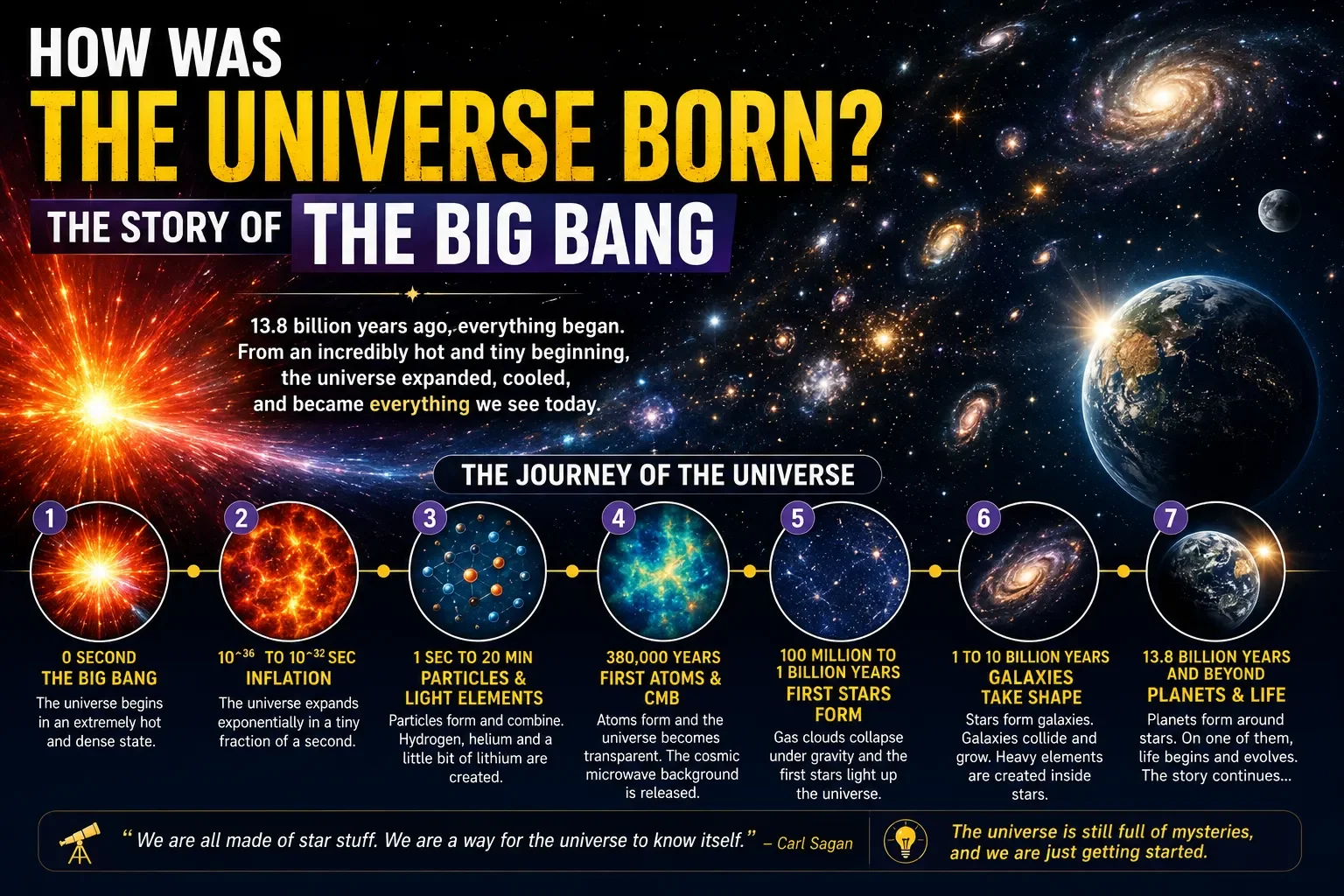
How Was the Universe Born? The Story of the Big Bang
Category: Space Technology
Date: 17 Aug, 2026 | 106 views
Imagine a time when there were no stars, no planets, no galaxies, no Earth—and not even the familiar space and time we know today.
Then something happened.
The universe began expanding from an extremely hot and dense early state, setting in motion a story that would eventually create galaxies, stars, planets, Earth—and ultimately, life.
Today, scientists estimate that the universe is about 13.8 billion years old. But what exactly happened at the beginning? What was the Big Bang? Was there anything before it? And how did an almost unimaginably hot early universe become the enormous cosmos we see today?
Let's travel back to the beginning.
What Is the Big Bang?
The Big Bang is not simply an explosion that happened somewhere in empty space.
According to modern cosmology, the universe itself expanded from an extremely hot, dense state. Space itself expanded, carrying matter and energy with it.
That means there was no ordinary "center" of the explosion from which everything flew outward. The expansion happened throughout the universe.
NASA describes the Big Bang as a widely accepted model explaining how the universe evolved from a hot, dense early state, with the universe expanding and cooling as it developed.
Scientists estimate that this expansion began approximately 13.8 billion years ago.
What Happened at the Very Beginning?
This is where science reaches its limits.
We have strong evidence about the universe's early evolution, but scientists do not yet know exactly what happened at the ultimate beginning.
Current models suggest that an extremely brief period of cosmic inflation occurred very early in the universe's history.
During inflation, space expanded extraordinarily rapidly. NASA notes that scientists still do not know what triggered inflation or what, if anything, came before it.
So the honest scientific answer is:
We know a great deal about the early universe, but we do not yet know what caused the beginning.
The Universe Was Extremely Hot
In its early stages, the universe was unimaginably hot and dense.
There were no ordinary stars or planets.
Instead, the universe was filled with a hot mixture of particles and radiation.
As space expanded, the universe began to cool.
This cooling allowed particles to form and eventually combine into the first atomic nuclei.
Within the first few minutes, conditions were cool enough for the formation of nuclei of light elements, primarily hydrogen and helium.
These simple elements would eventually become the raw material for stars and galaxies.
The First Atoms Took Much Longer
The universe did not become transparent immediately.
For roughly the first 380,000 years, it was filled with a hot plasma in which light constantly interacted with free electrons.
Light could not travel freely across the universe.
Then the universe cooled enough for electrons to combine with atomic nuclei and form atoms.
At that point, light could finally travel freely through space.
That ancient light still exists today.
Scientists call it the Cosmic Microwave Background, or CMB.
The Cosmic Microwave Background: A Baby Picture of the Universe
If the universe were a person, the Cosmic Microwave Background would be like its oldest surviving baby photograph.
The CMB comes from a time when the universe was only about 380,000 years old.
It is now detected as microwave radiation spread across the entire sky.
Satellites such as NASA's COBE and WMAP, along with ESA's Planck mission, have mapped this ancient radiation.
Tiny variations in the CMB reveal small differences in the density of the early universe.
Those tiny differences were incredibly important.
Over billions of years, gravity amplified them, eventually helping create the first stars and galaxies.
How Did the First Stars Form?
After the universe became transparent, there was still a long period without stars.
This era is sometimes called the cosmic dark ages.
The universe was filled primarily with hydrogen and helium gas.
Gravity slowly pulled some of this gas together.
As clouds of gas became denser, they collapsed under their own gravity.
Eventually, the pressure and temperature in their centers became high enough for nuclear fusion to begin.
The first stars were born.
These stars became cosmic factories.
Inside stars, nuclear reactions created elements heavier than hydrogen and helium.
When massive stars eventually died, some of these elements were released into space.
Those materials later became part of new generations of stars, planets and other cosmic objects.
In other words, the ingredients needed to build rocky planets like Earth were produced through generations of cosmic evolution.
From Stars to Galaxies
Stars did not remain isolated.
Gravity brought enormous numbers of stars together into galaxies.
Over billions of years, galaxies grew and evolved.
Some became enormous spiral galaxies, while others developed elliptical or irregular shapes.
Our home galaxy, the Milky Way, is one of these galaxies.
It contains enormous numbers of stars, including our Sun.
And somewhere around the Sun, billions of years later, a small rocky planet would form.
That planet would become Earth.
How Did Scientists Discover That the Universe Is Expanding?
For a long time, scientists did not know that the universe was expanding.
That changed dramatically in the 20th century.
Astronomers observed that light from distant galaxies was shifted toward the red end of the spectrum.
This is called cosmological redshift.
The farther away a galaxy is, the faster it generally appears to be moving away from us.
Edwin Hubble's observations provided crucial evidence that the universe is expanding.
This discovery changed our understanding of the cosmos.
If the universe is expanding today, scientists realized that going backward in time would mean the universe was once much smaller, hotter and denser.
That became one of the foundations of the Big Bang model.
The Big Bang Was Not an Explosion Into Empty Space
This is one of the biggest misconceptions about the Big Bang.
Imagine an explosion occurring inside an already existing room.
The explosion sends material outward through the room.
That is not what scientists mean by the Big Bang.
Instead, the space itself expanded.
A useful analogy is the surface of a balloon.
Imagine dots drawn on the surface of a balloon. As the balloon expands, every dot moves farther from every other dot.
There is no single dot that represents the center of the expansion on the surface.
The real universe is far more complicated than this analogy, but it helps explain why the Big Bang was not an explosion from one ordinary location into pre-existing space.
NASA specifically notes that galaxies are not simply rushing away from one central point; rather, the universe itself is expanding.
What Came Before the Big Bang?
This may be the biggest unanswered question of all.
The problem is that our current physical theories cannot yet give us a complete description of the ultimate beginning.
Some scientific models suggest possibilities involving quantum physics, inflation, cyclic universes or other scenarios.
But none has been confirmed as the definitive answer.
There is another profound issue:
If time itself is part of the universe and began with the Big Bang, then asking "What happened before the Big Bang?" may not have the same meaning as asking what happened yesterday.
NASA notes that scientists are not sure what came before cosmic inflation or what powered it.
So for now, the most accurate answer is:
We don't know.
And that uncertainty is one of the greatest frontiers of modern science.
How Do We Know the Big Bang Really Happened?
Scientists do not have a video recording of the beginning of the universe.
Instead, they have multiple independent pieces of evidence.
1. The Universe Is Expanding
Distant galaxies show evidence of expansion through their redshift.
This tells us that the universe is not static.
2. The Cosmic Microwave Background Exists
The universe is filled with a faint microwave glow that comes from its early hot phase.
This is one of the strongest pieces of evidence supporting the Big Bang model.
3. The Amount of Light Elements
The early universe produced large quantities of hydrogen and helium, along with small amounts of other light elements.
The observed proportions broadly agree with predictions from Big Bang nucleosynthesis.
4. The Large-Scale Structure of the Universe
The tiny variations seen in the CMB correspond to the early density differences that eventually grew into stars, galaxies and larger cosmic structures.
Together, these observations provide a powerful picture of a universe that began in a much hotter, denser state and has evolved for billions of years.
What Is the Universe Made Of?
The universe contains stars, planets, galaxies, gas, dust, radiation and many other forms of matter and energy.
But there is a surprising fact.
The ordinary matter that makes stars, planets and people is only a small fraction of the universe's total mass-energy content.
Observations from ESA's Planck mission estimated approximately:
4.9% — ordinary matter
26.8% — dark matter
68.3% — dark energy
Dark matter has not been directly observed, but its gravitational effects are evident. Dark energy is associated with the accelerating expansion of the universe.
The exact nature of both remains one of the biggest mysteries in physics.
Is the Universe Still Expanding?
Yes.
And something even more surprising is happening.
The expansion of the universe is accelerating.
Observations indicate that the expansion began speeding up billions of years ago.
Scientists call the unknown phenomenon responsible for this acceleration dark energy.
NASA estimates that dark energy makes up roughly 68–70% of the universe's mass-energy content, although its true nature remains unknown.
Where Are We in This Cosmic Story?
Think about the timeline.
13.8 billion years ago:
The universe began its expansion from an extremely hot and dense early state.
Seconds to minutes later:
Particles and light elements formed.
About 380,000 years later:
Atoms formed and the universe became transparent. The CMB was released.
Hundreds of millions of years later:
The first stars began forming.
Over billions of years:
Galaxies evolved and became increasingly complex.
About 4.6 billion years ago:
Our Sun and Solar System formed.
About 4.5 billion years ago:
Earth formed.
Billions of years later:
Life evolved on Earth.
Today:
A species on one small planet is using telescopes to look back toward the beginning of the universe.
That species is us.
Can We See the Beginning of the Universe?
Not directly.
The Big Bang itself is not something our telescopes can simply photograph.
The oldest electromagnetic light we can observe comes from roughly 380,000 years after the universe began expanding.
Before that, the universe was an opaque plasma that prevented light from traveling freely over long distances.
This means telescopes such as the James Webb Space Telescope cannot photograph the Big Bang itself.
Instead, Webb looks at extremely distant galaxies whose light has traveled for billions of years.
Because light takes time to travel, looking farther into space also means looking farther into the past.
James Webb and the Early Universe
The James Webb Space Telescope is helping astronomers study some of the earliest galaxies known.
Its infrared capabilities allow it to detect extremely distant objects whose light has been stretched to longer wavelengths by the expansion of the universe.
These observations help scientists investigate how the first galaxies formed and evolved.
But Webb is not looking directly at the Big Bang.
It is helping us understand what happened after the universe began.
Will the Universe Ever Stop Expanding?
Scientists do not yet know the ultimate fate of the universe with complete certainty.
If dark energy continues to drive accelerated expansion, galaxies outside our local gravitational neighborhood will eventually become increasingly distant.
Over unimaginably long periods of time, the universe could become colder, darker and more diffuse.
This possible future is often associated with a scenario known as heat death.
But the ultimate fate of the universe depends on the true nature of dark energy and other fundamental physics that scientists are still investigating.
The Biggest Mystery: Why Is There Something Rather Than Nothing?
The Big Bang model explains a great deal about the evolution of the early universe.
But it does not completely answer every philosophical question about existence.
Why did the universe begin?
Why do the laws of physics have the values we observe?
Why does matter exist?
Was there something before cosmic inflation?
Could there be other universes?
These questions sit at the boundary between physics, cosmology and philosophy.
Scientists continue searching for answers.
The Story Is Still Being Written
The universe began its long journey approximately 13.8 billion years ago.
From a hot, dense early state, it expanded and cooled.
Particles formed.
Atoms appeared.
The first stars ignited.
Galaxies emerged.
Stars created heavier elements.
Planets formed.
And eventually, on one small planet around one ordinary star, life appeared.
Billions of years later, that life evolved into creatures capable of looking back across cosmic time and asking:
How did all of this begin?
We have learned an extraordinary amount.
But the deepest mystery remains.
We know the universe has been expanding for about 13.8 billion years. We know what happened during many stages of its evolution. But we still don't know what ultimately caused the beginning—or whether "before the beginning" is even a meaningful question.
Perhaps future telescopes, particle accelerators and new theories will take us closer to the answer.
Until then, every galaxy we see is part of the same incredible story.
The story of a universe that began in an extreme early state—and is still expanding today.
References
NASA — The Big Bang and Early Universe
NASA — The Universe's History and Cosmic Inflation
NASA — Hubble and Cosmological Redshift
NASA — The James Webb Space Telescope and the Big Bang
NASA — Early Universe and Cosmic Inflation
NASA — Cosmic Microwave Background
ESA — Planck and the Cosmic Microwave Background
ESA — Planck Mission and the Age of the Universe
NASA — Dark Energy and Accelerating Expansion
ESA — Planck and the Early Universe
Related Posts in Space Technology
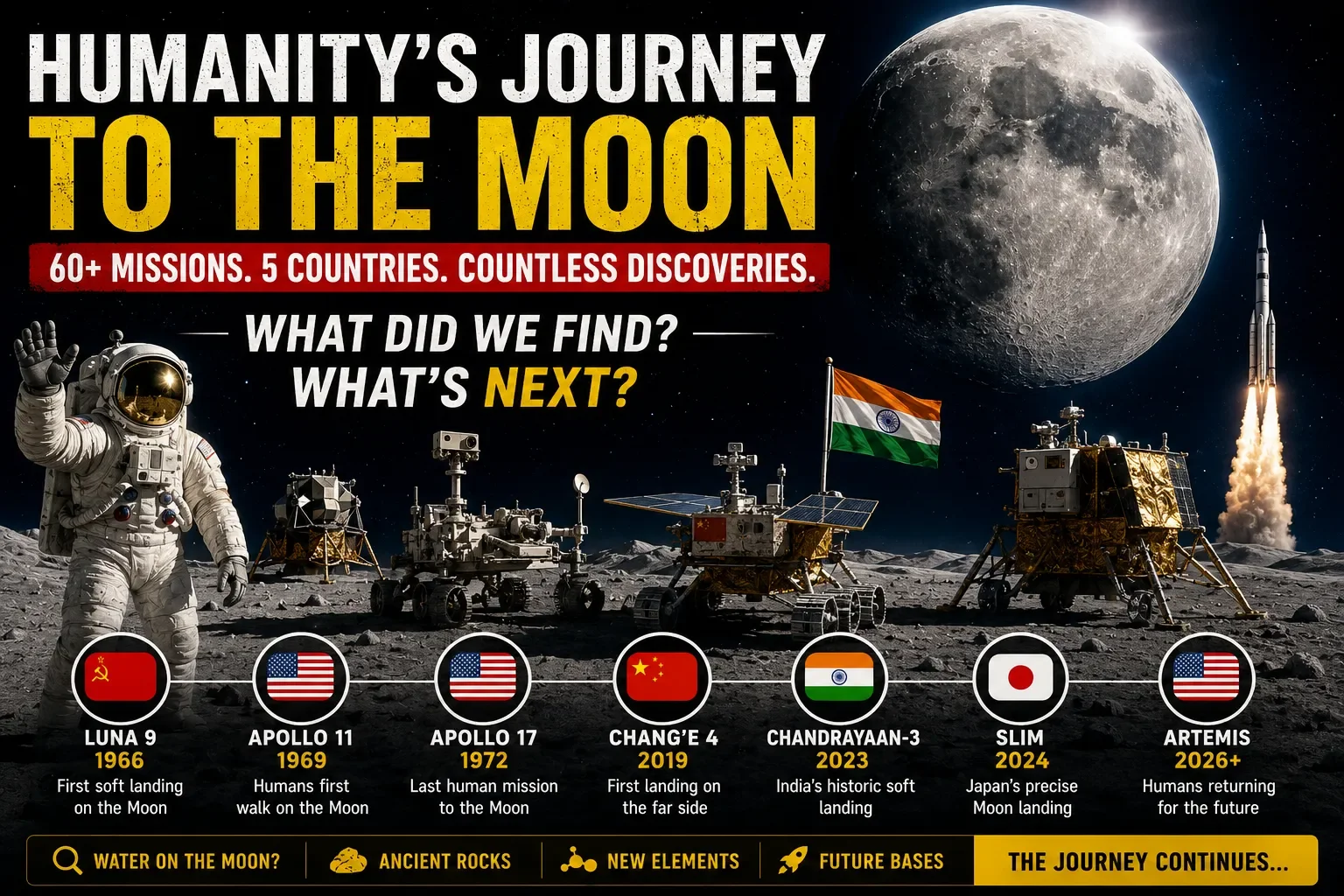
Moon Missions: How Many Have Reached the Moon, Who Sent Them, and What Did We Discover?
17 Aug, 2026Discover how many missions have explored the Moon, which countries sent them, what they discovered, …
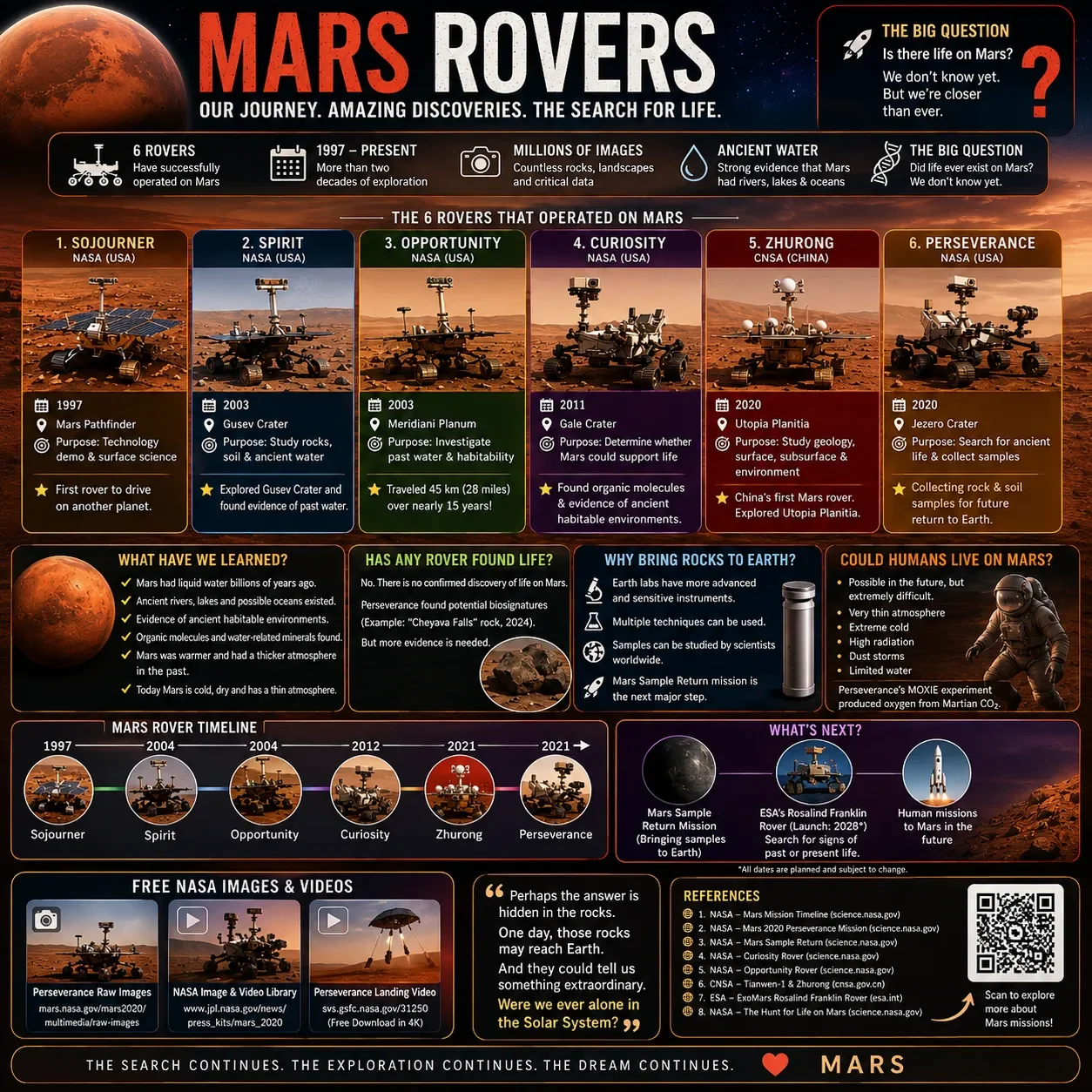
Mars Rovers: How Many Have Reached Mars, What Did They Discover, and Could Life Exist There?
17 Aug, 2026Mars has fascinated humans for centuries. Its reddish surface, ancient river-like channels, polar ic…
Reviews (0)
No reviews yet. Be the first!
Leave Feedback
Categories
- Space Technology 3
- AI & Prompt Engineering 3
- Art & Craft 2
- Yoga 2
- Design & Multimedia 2
- Tuition & Coaching 2
- Class 10 Tuition 2
- Online Classes 2
- Digital Marketing & SEO 1
- Cloud Computing (AWS, Azure, GCP) 1
- Data Science & Analytics 1
- Painting 1
- Quantum Computing 1
- Web Development 1
- DevOps & CI/CD 1
- Exam Preparation 1
- Cooking 1
- Photography & Videography 1
- Medical Entrance Coaching 1
- GRE Coaching 1
Tags
Recent Posts

The Path Beyond Suffering: Buddha’s Four Noble Truths, the Eightfold Way, and the Journey to Nirvana
02 Oct, 2026
Indian Philosophy and Philosophers: A Journey Through India’s Timeless Wisdom
30 Sep, 2026
GRE Coaching: Complete Guide to GRE Preparation, Classes, Fees & Career Opportunities
21 Aug, 2026
How Was the Universe Born? The Story of the Big Bang
17 Aug, 2026
Moon Missions: How Many Have Reached the Moon, Who Sent Them, and What Did We Discover?
17 Aug, 2026