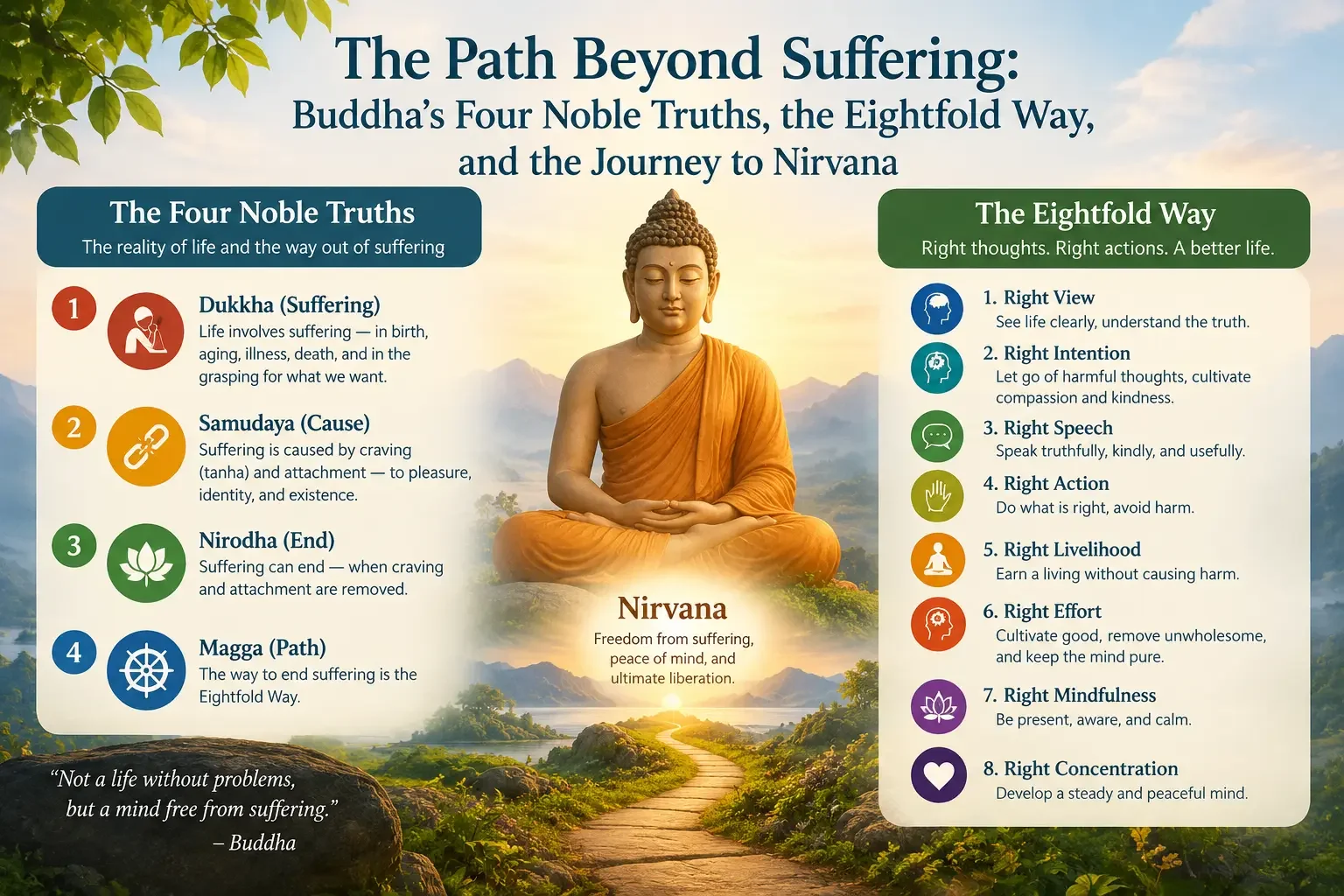
The Path Beyond Suffering: Buddha’s Four Noble Truths, the Eightfold Way, and the Journey to Nirvana
Category: Yoga
Date: 02 Oct, 2026 | 10 views
Throughout human history, people have searched for answers to some of life’s deepest questions: Why do we suffer? Why do happiness and success often feel temporary? Can the mind become completely free from fear, attachment, and dissatisfaction?
More than 2,500 years ago, Siddhartha Gautama, who became known as the Buddha, devoted his life to understanding these questions. His teachings were not simply about philosophy or belief. They presented a practical path for understanding the mind, overcoming suffering, and moving toward liberation.
At the heart of Buddha’s teachings are the Four Noble Truths, the Noble Eightfold Path, an understanding of reality and its impermanence, and the pursuit of Nirvana—a state described in Buddhist traditions as liberation from the cycle of suffering and rebirth.
Who Was Gautama Buddha?
Siddhartha Gautama was born into a royal family in the ancient region of the Indian subcontinent. Although he lived a life of comfort, encounters with sickness, old age, and death deeply affected him.
He eventually left his privileged life in search of an answer to human suffering. After years of spiritual practice and meditation, Siddhartha attained awakening while meditating under the Bodhi tree at Bodh Gaya.
After his awakening, he became known as the Buddha, meaning “the Awakened One.”
Rather than keeping his understanding to himself, Buddha spent the rest of his life teaching others a path toward understanding, ethical living, mental discipline, and liberation.
The Central Question: Why Do We Suffer?
One of the most important aspects of Buddha's teaching is the examination of dukkha.
Dukkha is often translated simply as “suffering,” but its meaning is broader. It can refer to physical and emotional suffering, dissatisfaction, instability, and the inability of temporary experiences to provide lasting fulfillment.
Even pleasant experiences change. Relationships change, possessions change, our bodies change, and circumstances change.
Buddha's teachings encourage people to understand this reality rather than remain trapped by attachment to things that cannot remain permanent.
The Four Noble Truths
The Four Noble Truths form one of the central foundations of Buddhist teaching.
1. The Truth of Dukkha — The Reality of Suffering
The first Noble Truth recognizes that suffering and dissatisfaction are part of conditioned existence.
Birth, aging, illness, death, separation from what we love, association with what we dislike, and not getting what we desire are traditionally described as forms of dukkha.
Even happiness can contain an element of uncertainty because it eventually changes.
The first truth does not mean that life contains nothing but suffering. Instead, it asks us to honestly recognize the unstable and unsatisfactory aspects of existence.
2. The Truth of the Origin of Suffering
The second Noble Truth explains that suffering has causes.
Buddhist teachings particularly emphasize craving or attachment (tanha).
Human beings may continuously desire pleasure, possessions, recognition, success, relationships, identity, or even continued existence.
When reality does not match our desires, dissatisfaction arises.
Attachment can therefore become a source of suffering because we attempt to hold onto things that are naturally changing.
3. The Truth of the Cessation of Suffering
The third Noble Truth teaches that suffering can cease.
When craving and attachment are brought to an end, liberation becomes possible.
This cessation is associated with Nirvana, which is one of the most important concepts in Buddhism.
Nirvana is not simply a place or a temporary feeling of happiness. It is traditionally understood as liberation from craving, ignorance, and the cycle of suffering.
4. The Truth of the Path Leading to the End of Suffering
The fourth Noble Truth provides a practical solution.
Buddha taught the Noble Eightfold Path as the way leading toward the cessation of suffering.
It is not merely a list of rules. It is a path involving wisdom, ethical conduct, and mental cultivation.
The Noble Eightfold Path
The Eightfold Path consists of eight interconnected practices.
1. Right Understanding
Right Understanding involves seeing reality more clearly, including understanding the Four Noble Truths, impermanence, karma, and the causes of suffering.
It encourages a person to look beyond assumptions and develop insight into the nature of life.
2. Right Intention
Right Intention concerns the direction of one's thoughts and motivations.
It encourages intentions based on renunciation, goodwill, compassion, and freedom from harmful desire.
3. Right Speech
Words can create harmony or conflict.
Right Speech encourages avoiding falsehood, harmful gossip, abusive language, and speech that causes unnecessary division.
Truthful, useful, kind, and appropriate communication becomes part of spiritual practice.
4. Right Action
Right Action refers to ethical behavior.
It traditionally includes avoiding killing, stealing, and sexual misconduct while developing respect for other living beings.
The purpose is to reduce harmful actions and create conditions for a peaceful mind.
5. Right Livelihood
Right Livelihood means earning a living without causing serious harm to others.
Buddhist teachings therefore connect spiritual development with everyday work and economic behavior.
How we earn and use resources can also influence our mind and our relationship with other people.
6. Right Effort
Spiritual progress requires consistent effort.
Right Effort involves preventing harmful mental states, abandoning those that have arisen, developing wholesome qualities, and maintaining them.
It is the practice of training the mind rather than allowing every thought or impulse to control our actions.
7. Right Mindfulness
Right Mindfulness means developing careful awareness of the body, feelings, mental states, and phenomena.
Instead of automatically reacting to every thought or emotion, mindfulness encourages observation and understanding.
Modern mindfulness practices have been influenced by Buddhist traditions, although contemporary mindfulness programs may differ from traditional Buddhist practice.
8. Right Concentration
Right Concentration refers to developing a stable and focused mind through meditation.
Deep concentration can support clarity, calmness, and insight.
Together, these eight elements form a path of wisdom, ethical conduct, and mental cultivation.
The Deeper Truth: Impermanence and the Nature of Reality
Buddhist philosophy places great importance on impermanence, known as anicca.
Everything conditioned is subject to change.
Our bodies change. Emotions change. Relationships change. Societies change. Wealth changes. Circumstances change.
Understanding impermanence does not mean that life has no value. Instead, it encourages us to experience life without demanding that temporary things remain permanent.
Buddhist teachings also emphasize anatta, often translated as “not-self.” This teaching challenges the idea of a permanent, unchanging self behind our changing experiences.
Together, teachings on impermanence, suffering, and not-self encourage deeper examination of how attachment and ignorance arise.
What Is the Ultimate Truth?
The idea of an “ultimate truth” in Buddhism is closely connected with seeing reality without the distortions created by ignorance and attachment.
Ordinary experience can make everything appear permanent, separate, and controllable. Buddhist insight challenges these assumptions.
The deeper understanding is that conditioned phenomena arise due to causes and conditions, change continuously, and cannot provide permanent satisfaction.
The purpose of this insight is not merely intellectual knowledge.
It is meant to transform how a person experiences life.
When we understand that everything conditioned changes, attachment can gradually weaken. When attachment weakens, suffering can also diminish.
The Road to Nirvana
Nirvana is one of the most profound concepts in Buddhism.
The word is often associated with the extinguishing of craving, hatred, and ignorance. It represents liberation rather than ordinary pleasure or temporary happiness.
The journey toward Nirvana is therefore not simply about collecting knowledge.
It involves transforming one's relationship with desire, anger, fear, ego, and attachment.
Meditation, ethical conduct, mindfulness, compassion, wisdom, and disciplined living all have an important place in Buddhist traditions.
The Noble Eightfold Path provides the framework for this transformation.
Nirvana Is More Than Happiness
Modern life often defines happiness through money, success, possessions, popularity, or comfort.
Buddhist teachings approach the question differently.
Pleasure can be valuable, but pleasure is temporary. If the mind becomes dependent upon constantly obtaining pleasant experiences, dissatisfaction can return whenever circumstances change.
Nirvana represents something fundamentally different: freedom from the craving and ignorance that keep suffering alive.
It is therefore better understood as liberation rather than simply happiness.
Compassion and Wisdom
Buddha's path is not only about personal liberation.
Compassion is also an important part of Buddhist practice.
When a person understands suffering deeply, compassion toward other beings can develop.
Wisdom helps us understand reality, while compassion influences how we treat others.
The combination of wisdom, ethical conduct, compassion, and mental discipline forms an important part of the Buddhist path.
Can Buddha's Teachings Be Applied to Modern Life?
Although Buddhism originated in ancient India, many of its questions remain relevant today.
People still experience anxiety, attachment, anger, disappointment, competition, loss, and uncertainty.
The teachings encourage us to pause before reacting, examine our desires, become aware of our thoughts, speak carefully, act ethically, and understand that circumstances are constantly changing.
For a modern person, the Eightfold Path can be approached as a framework for developing a more aware and disciplined way of living.
A Simple Way to Practice
A person interested in Buddha's teachings can begin with simple practices:
Observe thoughts without immediately reacting to them.
Practice mindful breathing and meditation.
Speak truthfully and avoid unnecessary harm.
Develop compassion toward others.
Notice attachment to possessions, recognition, and expectations.
Remember that circumstances are temporary.
Examine the causes of anger, fear, and craving.
Make ethical choices in daily life.
Develop wisdom through reflection and learning.
Small changes in awareness can gradually influence everyday behavior.
The Journey Within
The Buddha's teaching can be understood as a journey from ignorance to understanding, attachment to freedom, and unconscious reaction to mindful awareness.
The Four Noble Truths explain the problem.
The Eightfold Path explains the practice.
Insight into impermanence and the nature of reality deepens understanding.
And Nirvana represents the liberation toward which the Buddhist path is directed.
The journey is ultimately an inward one.
It does not depend simply on changing the outside world. Instead, it asks us to understand the mind that experiences the world.
Conclusion
The teachings of Gautama Buddha offer a profound examination of suffering, desire, change, and liberation.
The Four Noble Truths identify suffering, its origin, its cessation, and the path leading toward its cessation.
The Noble Eightfold Path provides practical guidance through right understanding, intention, speech, action, livelihood, effort, mindfulness, and concentration.
Beyond these teachings lies a deeper exploration of impermanence, not-self, craving, and the nature of reality.
The destination is described as Nirvana — liberation from the causes of suffering.
Perhaps the most meaningful aspect of Buddha's teaching is that understanding is not presented as something to be accepted blindly. The path emphasizes practice, observation, discipline, and direct insight.
The journey begins with a simple but powerful question:
If we can understand the causes of suffering, can we also discover a way beyond it?
For more than two millennia, this question has remained at the heart of the Buddhist path.
Related Posts in Yoga
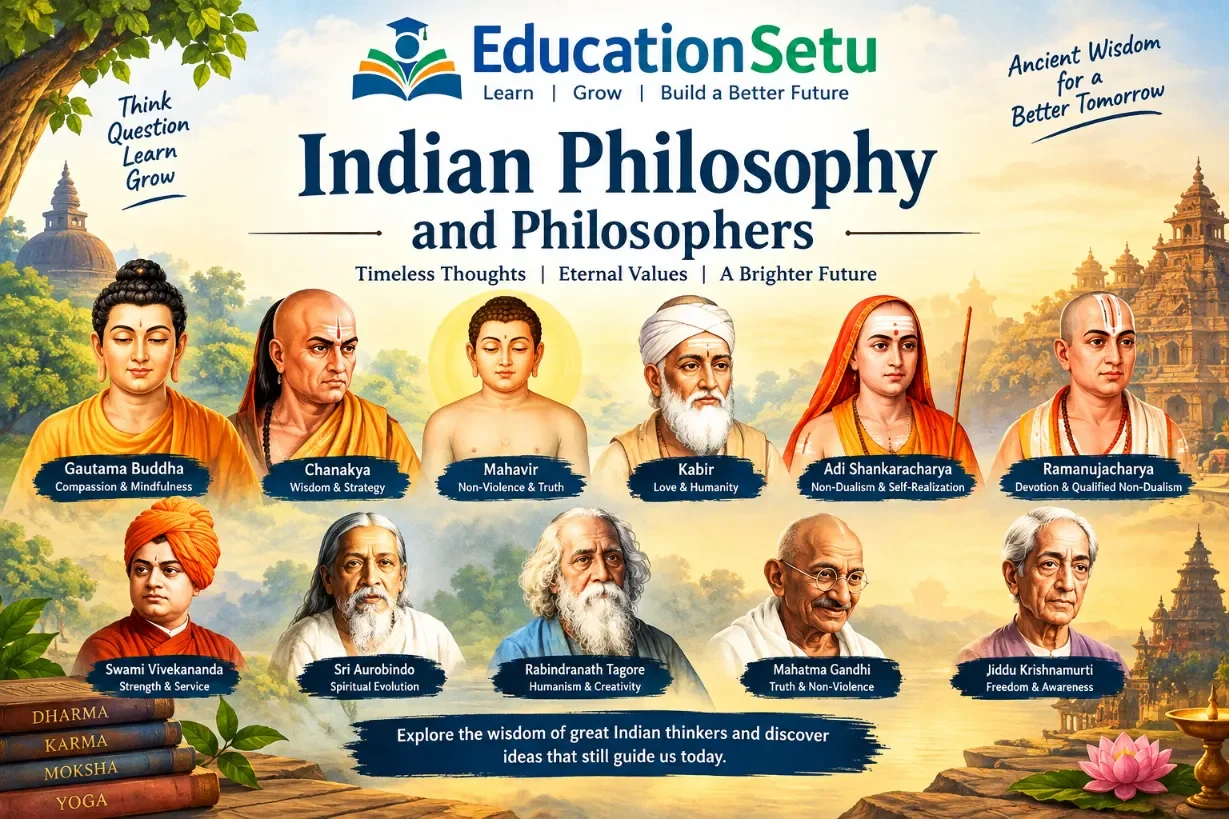
Indian Philosophy and Philosophers: A Journey Through India’s Timeless Wisdom
30 Sep, 2026Indian philosophy remains relevant in the modern world because many of its questions are universal.…
Reviews (0)
No reviews yet. Be the first!
Leave Feedback
Categories
- Space Technology 3
- AI & Prompt Engineering 3
- Art & Craft 2
- Yoga 2
- Design & Multimedia 2
- Tuition & Coaching 2
- Class 10 Tuition 2
- Online Classes 2
- Painting 1
- Digital Marketing & SEO 1
- Cloud Computing (AWS, Azure, GCP) 1
- Data Science & Analytics 1
- Quantum Computing 1
- Web Development 1
- DevOps & CI/CD 1
- Exam Preparation 1
- Cooking 1
- Photography & Videography 1
- Medical Entrance Coaching 1
- GRE Coaching 1
Tags
Recent Posts
The Path Beyond Suffering: Buddha’s Four Noble Truths, the Eightfold Way, and the Journey to Nirvana
02 Oct, 2026
Indian Philosophy and Philosophers: A Journey Through India’s Timeless Wisdom
30 Sep, 2026
GRE Coaching: Complete Guide to GRE Preparation, Classes, Fees & Career Opportunities
21 Aug, 2026
How Was the Universe Born? The Story of the Big Bang
17 Aug, 2026
Moon Missions: How Many Have Reached the Moon, Who Sent Them, and What Did We Discover?
17 Aug, 2026