Mars Rovers: How Many Have Reached Mars, What Did They Discover, and Could Life Exist There?
Category: Space Technology
Date: 17 Aug, 2026 | 124 views
Mars has fascinated humans for centuries. Its reddish surface, ancient river-like channels, polar ice caps, volcanoes and enormous canyons have made it one of the most important targets in the search for life beyond Earth.
But how much do we actually know about Mars?
A large part of our knowledge comes from robotic explorers. These machines have traveled across the Martian surface, photographed rocks and landscapes, studied the atmosphere and soil, searched for evidence of ancient water, and collected rock samples for future analysis.
How Many Rovers Have Operated on Mars?
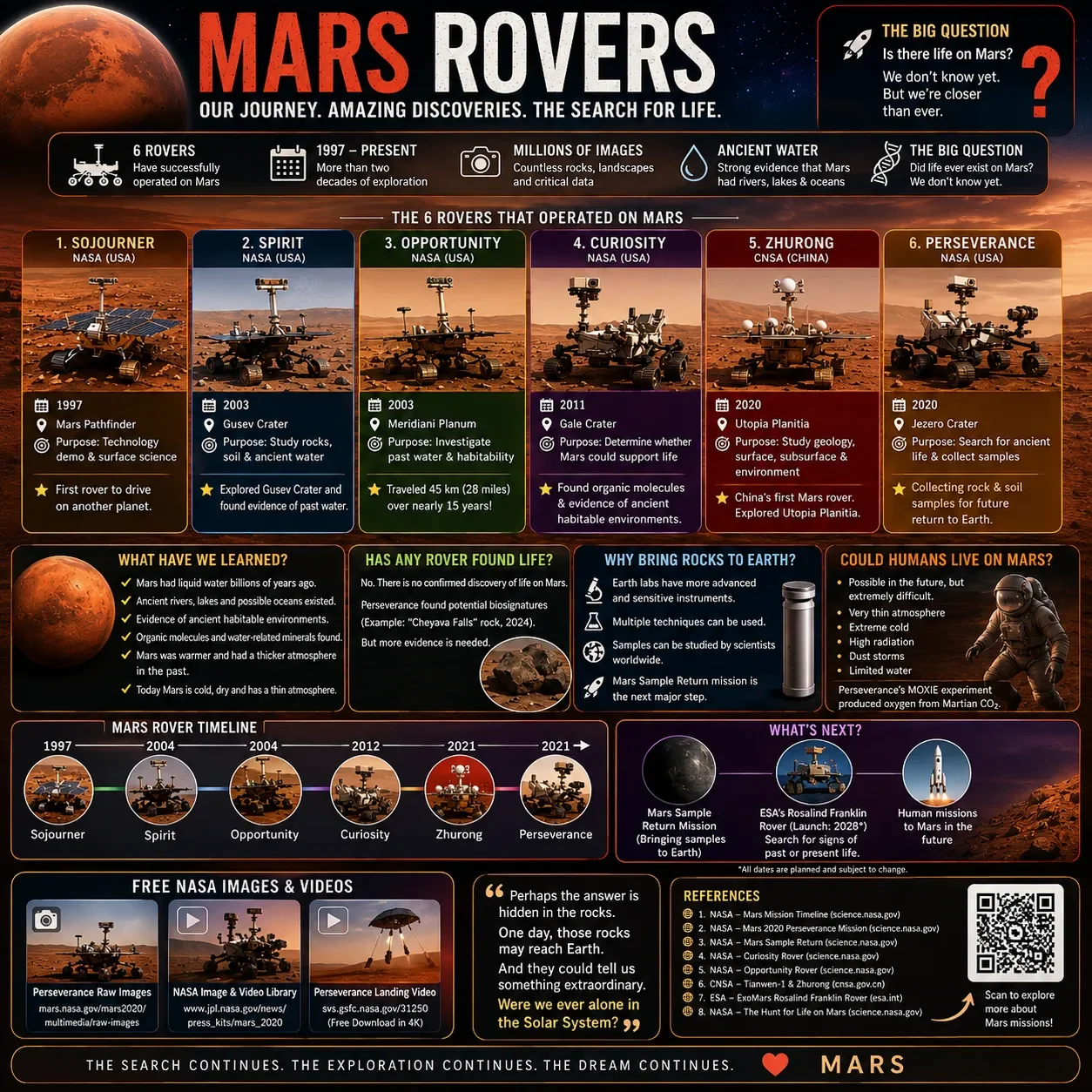
If we count successful wheeled rovers that reached the Martian surface and carried out surface operations, six rovers have operated on Mars so far:
Sojourner — NASA, 1997
Spirit — NASA, 2004
Opportunity — NASA, 2004
Curiosity — NASA, 2012
Zhurong — China, 2021
Perseverance — NASA, 2021
NASA's five rovers are Sojourner, Spirit, Opportunity, Curiosity and Perseverance. China's Zhurong became the sixth rover to operate on Mars.
It is worth noting that many other spacecraft have visited Mars, including orbiters and stationary landers. They are not counted as rovers because they could not drive across the surface.
1. Sojourner — The First Successful Mars Rover
Country/Agency: United States — NASA
Mission: Mars Pathfinder
Launch: December 1996
Landing: July 4, 1997
Sojourner was a historic little rover. NASA's Mars Pathfinder mission landed on Mars on July 4, 1997, and Sojourner became the first successful rover to drive on another planet.
The rover was much smaller than today's Curiosity and Perseverance. It was designed primarily as a technology demonstration and to study Martian rocks and soil.
Sojourner demonstrated that a small robotic vehicle could safely move around the Martian surface while communicating with a lander and scientists on Earth. Its success helped pave the way for much more ambitious Mars rovers.
2. Spirit — Exploring Mars' Ancient Water
Country/Agency: United States — NASA
Launch: June 10, 2003
Landing: January 4, 2004
Spirit was one of two twin NASA Mars Exploration Rovers. The other was Opportunity.
Their major scientific goal was to investigate Martian rocks and soil for evidence that liquid water had existed on Mars in the past.
Spirit explored the Gusev Crater region and discovered geological evidence that helped scientists understand the planet's ancient watery history. The rover greatly exceeded its original planned mission duration.
3. Opportunity — The Rover That Refused to Stop
Country/Agency: United States — NASA
Launch: July 7, 2003
Landing: January 24, 2004
Opportunity became one of the most successful planetary missions ever conducted.
Its original mission was designed to last only about 90 Martian days, but Opportunity continued working for almost 15 years.
The rover found evidence that Mars had once experienced environments where liquid water was present and where conditions may have been suitable for microbial life.
By the end of its mission, Opportunity had traveled more than 45 kilometers (28 miles) across the Martian surface. It finally stopped communicating after a planet-wide dust storm in 2018. NASA officially ended the mission in February 2019.
4. Curiosity — Investigating Whether Mars Could Support Life
Country/Agency: United States — NASA
Launch: November 26, 2011
Landing: August 6, 2012
Curiosity was a major technological step forward. It was much larger and more scientifically capable than Spirit and Opportunity.
Its main question was:
Did Mars ever have environmental conditions capable of supporting microbial life?
Curiosity landed inside Gale Crater and has studied rocks, minerals, soil and the Martian atmosphere.
Its scientific instruments found chemical and mineral evidence of ancient habitable environments. The rover has also detected organic molecules on Mars. Organic molecules are important because they are carbon-containing compounds, but their presence alone does not prove that life existed there.
5. Zhurong — China's First Mars Rover
Country/Agency: China — China National Space Administration (CNSA)
Mission: Tianwen-1
Launch: July 23, 2020
Landing: May 15, 2021
Surface operations began: May 22, 2021
China's Tianwen-1 mission was particularly ambitious because it attempted to achieve Mars orbiting, landing and rover operations as part of one mission.
The Zhurong rover landed in Utopia Planitia, a large plain on Mars.
It studied the Martian surface, rocks, sand dunes, subsurface structure, magnetic environment and weather. Chinese scientists also reported evidence related to past water activity and hydrated minerals.
Zhurong's successful landing made China the second nation to successfully land and operate a rover on Mars.
6. Perseverance — The Search for Ancient Life
Country/Agency: United States — NASA
Launch: July 30, 2020
Landing: February 18, 2021
Landing site: Jezero Crater
Perseverance is currently one of the most advanced robotic explorers ever sent to Mars.
Its mission is different from simply asking whether Mars was once habitable. Perseverance is specifically searching for signs of ancient microbial life and collecting carefully selected rock and regolith samples.
Scientists believe Jezero Crater once contained a lake and river delta more than 3.5 billion years ago. Such environments could potentially have supported microbial life and could preserve evidence of ancient biological activity.
The rover has collected and stored cores of Martian rocks and regolith that scientists hope can eventually be brought back to Earth for much more detailed laboratory analysis.
What Important Information Have the Rovers Given Us?
Mars was not always the cold, dry desert we see today.
Evidence gathered by multiple missions indicates that ancient Mars had substantially more water and a thicker atmosphere than it has today. Scientists have found ancient river channels, lake deposits, water-altered minerals and other geological clues.
The discoveries have changed the central question from:
"Was there ever water on Mars?"
to:
"Could that ancient water-rich environment have supported life?"
NASA describes Mars as a planet that was much warmer and wetter billions of years ago.
Has Any Rover Found Life on Mars?
No. There is still no confirmed discovery of life on Mars.
This is one of the most important points to understand.
The rovers have found several things that make Mars scientifically exciting:
Evidence of ancient liquid water
Ancient lake and river environments
Organic molecules
Minerals associated with water
Environments that may once have been habitable
Rocks capable of preserving possible biological signatures
However, none of these discoveries by themselves proves that life existed on Mars.
A Major New Clue: Perseverance and "Cheyava Falls"
Perseverance made a particularly interesting discovery in 2024 while studying a rock nicknamed Cheyava Falls.
The rock contained organic material and features that scientists consider potential biosignatures. NASA reports that subsequent peer review validated the finding as a potential biosignature — meaning the evidence is interesting and could be consistent with ancient biological activity.
But there is an important scientific caution:
Potential biosignature does not mean confirmed extraterrestrial life.
Scientists need additional evidence before they can determine whether the features were produced by biology or by non-biological chemical processes.
This is exactly why bringing Martian samples back to Earth is so important.
Why Bring Mars Rocks Back to Earth?
A rover has excellent scientific instruments, but laboratories on Earth have equipment that is much larger, more sensitive and more flexible.
Scientists could examine Martian samples using many different techniques and allow independent research teams around the world to study the same material.
NASA's Mars Sample Return effort is intended to bring samples collected by Perseverance back to Earth for detailed scientific analysis.
If the samples contain convincing evidence of ancient microbial life, it could become one of the greatest scientific discoveries in human history.
Could Humans Live on Mars?
Humans living on Mars is physically possible in principle, but it would be extremely difficult.
Mars has:
A very thin atmosphere
Extremely cold conditions
High radiation exposure
Dust storms
No breathable oxygen-rich atmosphere
Limited easily accessible liquid water on the surface
Interestingly, Perseverance has already demonstrated technology that can produce oxygen from Martian atmospheric carbon dioxide. Its MOXIE experiment successfully produced oxygen on Mars, demonstrating a technology that could potentially be useful for future human missions.
However, producing oxygen experimentally is very different from creating a complete human settlement. Humans would require reliable systems for air, water, food, shelter, radiation protection, energy and medical support.
What Is Next for Mars Exploration?
The next major step is to examine Mars samples in Earth-based laboratories.
Europe is also developing the Rosalind Franklin rover as part of the ExoMars program. Its mission is designed to search for signs of past or present life, including drilling beneath the Martian surface where potential biosignatures may be better protected from radiation.
ESA currently lists 2028 as the planned launch opportunity for the Rosalind Franklin rover mission.
The search for life on Mars is therefore far from over.
The Big Question: Is There Life on Mars?
The scientifically honest answer is:
We don't know yet.
Mars clearly had environments that were more favorable to life billions of years ago. Water existed, lakes and rivers formed, and some rocks preserve chemical evidence of potentially habitable conditions.
The discovery of potential biosignatures by Perseverance makes the question even more exciting, but scientists have not yet confirmed that life ever existed on Mars.
Perhaps the answer is hidden inside one of the rocks currently sitting on Mars.
One day, those rocks may reach Earth.
And they could tell us something extraordinary:
Were we ever alone in the Solar System?
Mars Rover Timeline at a Glance
| Rover | Country/Agency | Launch | Mars Landing | Main Purpose |
|---|---|---|---|---|
| Sojourner | NASA, USA | 1996 | 1997 | Technology demonstration and surface science |
| Spirit | NASA, USA | 2003 | 2004 | Study rocks, soil and ancient water |
| Opportunity | NASA, USA | 2003 | 2004 | Investigate evidence of past water and habitability |
| Curiosity | NASA, USA | 2011 | 2012 | Determine whether Mars could support microbial life |
| Zhurong | CNSA, China | 2020 | 2021 | Study geology, surface, subsurface and environment |
| Perseverance | NASA, USA | 2020 | 2021 | Search for ancient life and collect samples |
Free NASA Images and Videos
NASA provides a huge collection of Mars images and videos that can be used for educational and informational purposes, subject to NASA's media-use guidelines.
Mars Perseverance Raw Images:
NASA Perseverance Raw Images
This collection contains hundreds of thousands of images taken by Perseverance's cameras.
NASA Mars Images and Video Library:
NASA Image and Video Library / Perseverance Media
Free downloadable Perseverance landing video:
NASA — Perseverance Rover's Descent and Touchdown on Mars
NASA provides downloadable MP4/WebM versions, including 1080p and 4K versions, on its media site.
Official NASA YouTube video:
References
Related Posts in Space Technology

How Was the Universe Born? The Story of the Big Bang
17 Aug, 2026Imagine a time when there were no stars, no planets, no galaxies, no Earth—and not even the famili…
Moon Missions: How Many Have Reached the Moon, Who Sent Them, and What Did We Discover?
17 Aug, 2026Discover how many missions have explored the Moon, which countries sent them, what they discovered, …
Reviews (0)
No reviews yet. Be the first!
Leave Feedback
Categories
- Space Technology 3
- AI & Prompt Engineering 3
- Design & Multimedia 2
- Tuition & Coaching 2
- Class 10 Tuition 2
- Online Classes 2
- Yoga 2
- Art & Craft 2
- Quantum Computing 1
- Web Development 1
- DevOps & CI/CD 1
- Cooking 1
- Exam Preparation 1
- Photography & Videography 1
- Medical Entrance Coaching 1
- GRE Coaching 1
- Painting 1
- Digital Marketing & SEO 1
- Cloud Computing (AWS, Azure, GCP) 1
- Data Science & Analytics 1
Tags
Recent Posts

The Path Beyond Suffering: Buddha’s Four Noble Truths, the Eightfold Way, and the Journey to Nirvana
02 Oct, 2026
Indian Philosophy and Philosophers: A Journey Through India’s Timeless Wisdom
30 Sep, 2026
GRE Coaching: Complete Guide to GRE Preparation, Classes, Fees & Career Opportunities
21 Aug, 2026
How Was the Universe Born? The Story of the Big Bang
17 Aug, 2026
Moon Missions: How Many Have Reached the Moon, Who Sent Them, and What Did We Discover?
17 Aug, 2026