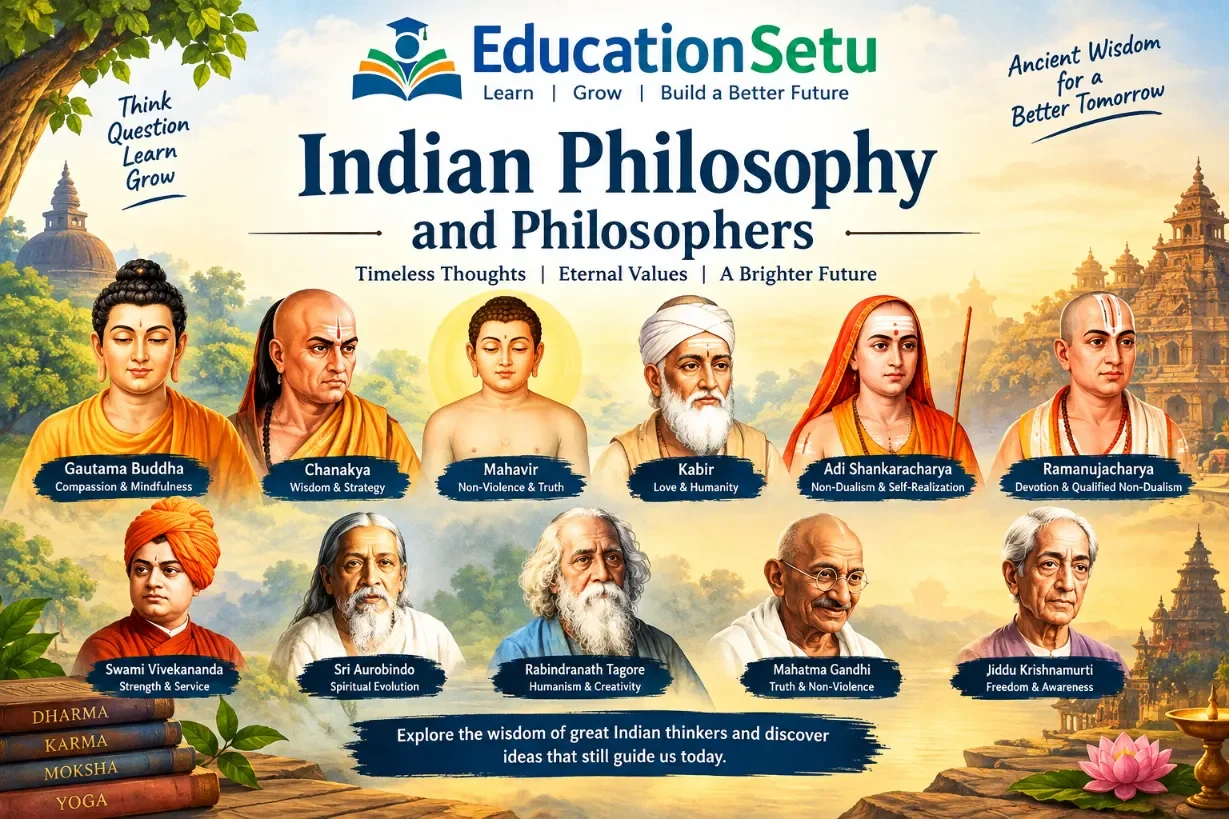
Indian Philosophy and Philosophers: A Journey Through India’s Timeless Wisdom
Category: Yoga
Date: 30 Sep, 2026 | 3 views
Indian philosophy is one of the oldest and most diverse philosophical traditions in the world. For thousands of years, Indian thinkers have explored profound questions about life, consciousness, knowledge, reality, morality, happiness, and the relationship between human beings and the universe.
Unlike philosophy that focuses only on theoretical questions, Indian philosophy often connects knowledge with practical living. It encourages people to understand themselves, control their desires, develop wisdom, and discover the deeper meaning of life.
From the teachings of the Vedas and Upanishads to the ideas of Gautama Buddha, Mahavira, Adi Shankaracharya, Swami Vivekananda, and Mahatma Gandhi, Indian philosophical thought has influenced generations across the world.
What Is Indian Philosophy?
Indian philosophy refers to the philosophical traditions that developed in the Indian subcontinent. It includes different schools of thought, including both theistic and non-theistic traditions.
The major classical schools of Indian philosophy include:
Nyaya – Philosophy of logic and reasoning
Vaisheshika – Study of reality, matter, and categories of existence
Samkhya – Understanding consciousness and nature
Yoga – Philosophy of discipline, meditation, and self-realization
Mimamsa – Interpretation of Vedic knowledge and duties
Vedanta – Philosophy concerning the Upanishads, Brahman, Atman, and ultimate reality
Indian philosophical traditions also include Buddhism, Jainism, and several other important schools of thought.
Major Ideas of Indian Philosophy
1. Dharma
Dharma is one of the important concepts in Indian thought. It broadly refers to duty, righteousness, ethical conduct, and the principles that help maintain harmony in life and society.
The meaning of Dharma can vary depending on context, but it generally encourages individuals to perform their responsibilities with integrity.
2. Karma
The concept of Karma suggests that actions have consequences. Our thoughts, words, and actions influence our future experiences.
Karma is not simply about reward and punishment. It is also a philosophical framework for understanding responsibility and ethical action.
3. Moksha
Moksha refers to liberation from the cycle of birth and death. Many Indian philosophical traditions consider spiritual liberation to be one of the highest goals of human life.
Different philosophical schools explain the path to liberation differently—through knowledge, meditation, devotion, disciplined action, or a combination of these.
4. Atman and Brahman
The concepts of Atman and Brahman are particularly important in Vedanta philosophy.
Atman generally refers to the deeper self or inner essence, while Brahman refers to ultimate reality. Different schools of Vedanta interpret their relationship in different ways.
5. Yoga and Meditation
Yoga is not limited to physical exercises. In Indian philosophical traditions, Yoga represents a disciplined path involving the body, mind, ethics, concentration, and meditation.
Meditation has also played a significant role in Indian traditions as a method of developing awareness, concentration, and inner peace.
Famous Indian Philosophers and Thinkers
1. Gautama Buddha
Gautama Buddha is one of the most influential spiritual philosophers in Indian history.
His teachings focus on understanding suffering and discovering a path toward its cessation. The Four Noble Truths and the Noble Eightfold Path form important foundations of Buddhist philosophy.
Buddha encouraged people to develop wisdom, ethical conduct, mindfulness, and compassion rather than blindly accepting ideas.
2. Mahavira
Mahavira was one of the most important teachers of Jainism.
Jain philosophy strongly emphasizes Ahimsa, or non-violence. It also teaches principles such as truth, non-stealing, non-attachment, and disciplined living.
Mahavira's teachings continue to influence discussions about ethics, compassion, environmental responsibility, and peaceful living.
3. Adi Shankaracharya
Adi Shankaracharya was a major philosopher of the Advaita Vedanta tradition.
His philosophy emphasizes the fundamental unity of ultimate reality and the self. Advaita Vedanta teaches that ignorance prevents human beings from recognizing the true nature of reality.
Shankaracharya's philosophical works had a profound influence on Hindu thought and Vedanta.
4. Ramanujacharya
Ramanujacharya was an influential philosopher associated with Vishishtadvaita Vedanta, or qualified non-dualism.
Unlike Advaita Vedanta, which emphasizes the ultimate non-duality of reality, Vishishtadvaita explains reality through a qualified unity in which individual souls and the universe have a meaningful relationship with the Supreme Reality.
His philosophy also had a significant influence on the Bhakti tradition.
5. Swami Vivekananda
Swami Vivekananda played an important role in introducing Indian philosophical ideas to audiences outside India.
He emphasized practical Vedanta, self-confidence, service, spiritual development, and the unity of religions.
His famous message encouraged individuals to recognize their inner strength and work for the welfare of humanity.
6. Sri Aurobindo
Sri Aurobindo developed an influential vision of spiritual evolution.
His philosophy combined elements of Indian spiritual traditions with an evolutionary understanding of human consciousness. He proposed that human beings have the potential for higher spiritual development.
His ideas are often associated with Integral Yoga.
7. Rabindranath Tagore
Rabindranath Tagore was a poet, philosopher, educator, and thinker.
His philosophy emphasized humanism, freedom, creativity, nature, education, and the unity of humanity.
Tagore believed education should encourage curiosity, creativity, and a meaningful relationship between individuals and the natural world.
8. Mahatma Gandhi
Mahatma Gandhi developed a practical philosophy based on Ahimsa and Satyagraha.
Ahimsa means non-violence, while Satyagraha can be understood as a method of pursuing truth through non-violent resistance.
Gandhi demonstrated how philosophical principles could be applied to social and political movements.
9. Jiddu Krishnamurti
Jiddu Krishnamurti was a modern Indian philosopher and spiritual thinker known for his discussions about freedom, awareness, fear, thought, and self-understanding.
He encouraged individuals to observe their own thoughts and experiences rather than simply following established beliefs or authorities.
Why Is Indian Philosophy Important Today?
Indian philosophy remains relevant in the modern world because many of its questions are universal.
People today continue to struggle with stress, anxiety, materialism, competition, conflict, and questions about the meaning of life. Indian philosophical traditions offer different approaches to understanding the mind, developing self-awareness, practicing compassion, and living ethically.
Concepts such as mindfulness, meditation, Yoga, non-violence, self-discipline, and responsible action have gained worldwide interest.
However, Indian philosophy is much broader than meditation or Yoga. It represents a vast intellectual tradition involving logic, metaphysics, ethics, epistemology, consciousness, language, spirituality, and social thought.
Indian Philosophy and Education
Indian philosophy has a special connection with education.
Traditional Indian educational systems emphasized not only the acquisition of information but also character development, discipline, self-knowledge, and ethical living.
Modern education can also benefit from these ideas by encouraging students to:
Think critically
Question assumptions
Develop self-awareness
Respect different viewpoints
Practice ethical decision-making
Understand their responsibilities
Develop emotional and social intelligence
Education should not only prepare students for employment. It should also help them become thoughtful, responsible, and compassionate human beings.
Conclusion
Indian philosophy represents a rich intellectual heritage that has evolved over thousands of years. From the Upanishadic search for ultimate reality to Buddha's teachings on suffering, Mahavira's emphasis on non-violence, Shankaracharya's Advaita Vedanta, Vivekananda's practical Vedanta, Tagore's humanism, and Gandhi's philosophy of non-violence, Indian thinkers have offered diverse approaches to understanding life.
Studying Indian philosophy can help us look beyond the surface of everyday life and ask deeper questions about who we are, how we should live, and what constitutes a meaningful life.
For students and lifelong learners, Indian philosophy is not merely a subject from history. It is an opportunity to explore ideas about knowledge, consciousness, ethics, self-discovery, and human values that remain relevant even in the modern world.
You May Also Like

Best Online Classes in India – Find Expert Teachers in Delhi, Mumbai, Bangalore, Hyderabad & All Major Cities
14 Jul, 2026Reviews (0)
No reviews yet. Be the first!
Leave Feedback
Categories
- Space Technology 3
- AI & Prompt Engineering 3
- Art & Craft 2
- Design & Multimedia 2
- Tuition & Coaching 2
- Class 10 Tuition 2
- Online Classes 2
- Cloud Computing (AWS, Azure, GCP) 1
- Data Science & Analytics 1
- Yoga 1
- Painting 1
- Digital Marketing & SEO 1
- DevOps & CI/CD 1
- Quantum Computing 1
- Web Development 1
- Cooking 1
- Exam Preparation 1
- Medical Entrance Coaching 1
- GRE Coaching 1
- Photography & Videography 1
Tags
Recent Posts
Indian Philosophy and Philosophers: A Journey Through India’s Timeless Wisdom
30 Sep, 2026
GRE Coaching: Complete Guide to GRE Preparation, Classes, Fees & Career Opportunities
21 Aug, 2026
How Was the Universe Born? The Story of the Big Bang
17 Aug, 2026
Moon Missions: How Many Have Reached the Moon, Who Sent Them, and What Did We Discover?
17 Aug, 2026
Mars Rovers: How Many Have Reached Mars, What Did They Discover, and Could Life Exist There?
17 Aug, 2026