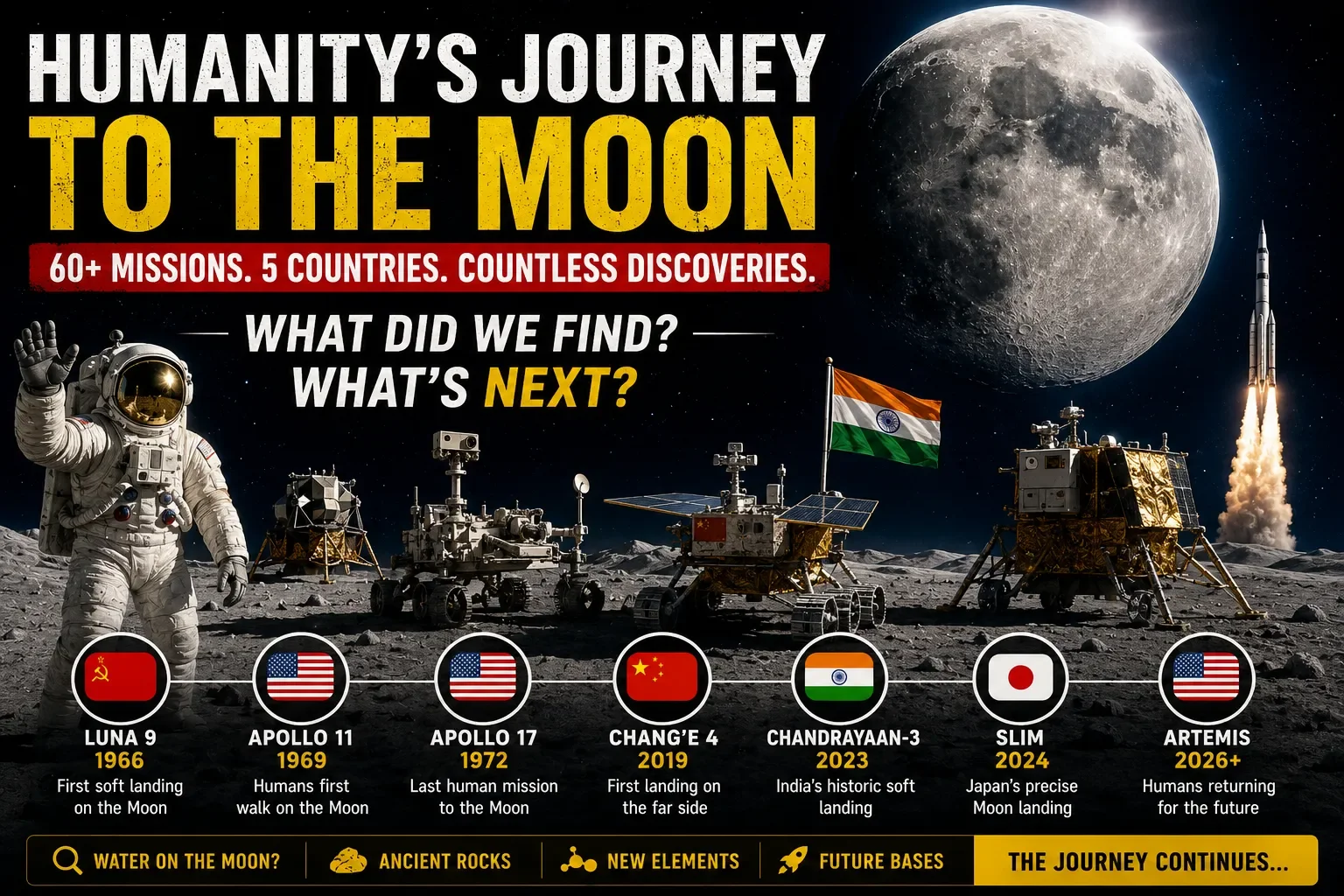
Moon Missions: How Many Have Reached the Moon, Who Sent Them, and What Did We Discover?
Category: Space Technology
Date: 17 Aug, 2026 | 134 views
What if I told you that humans have been sending spacecraft to the Moon for more than six decades—and some of these missions completely changed our understanding of our nearest cosmic neighbor?
From the Soviet Union's early Luna spacecraft to India's Chandrayaan-3 and China's Chang'e missions, the Moon has become one of the most explored worlds beyond Earth.
But how many missions have actually gone to the Moon? Which countries sent them? What did they discover? And why are countries suddenly returning to the Moon after decades?
Let's take a journey through the history of lunar exploration.
How Many Missions Have Gone to the Moon?
There is no single simple number because lunar missions have had many different purposes.
Some spacecraft simply flew past the Moon. Others entered lunar orbit. Some intentionally crashed into the surface to study it. Others landed, deployed rovers, collected samples, or carried astronauts.
NASA's lunar mission database documents missions from the early 1960s through the modern Artemis era, including missions from the United States, Soviet Union/Russia, Japan, China, India, Europe, South Korea and commercial organizations.
By 2026, lunar exploration has included hundreds of spacecraft and mission attempts when all categories and countries are considered.
But only a much smaller number have successfully achieved a soft landing.
NASA notes that, as of January 2024, four nations had successfully landed spacecraft on the Moon: the Soviet Union, United States, China and India. Japan later achieved a successful lunar soft landing with SLIM in January 2024, making the broader list of successful lunar-landing nations five.
The Beginning: The Soviet Union's Luna Missions
The story of lunar exploration began during the Space Race between the Soviet Union and the United States.
In 1959, the Soviet Union's Luna 1 became the first spacecraft to fly past the Moon.
Later that same year, Luna 2 became the first human-made object to reach the lunar surface by impacting it.
Then came another historic achievement.
In 1966, Luna 9 achieved the first successful soft landing on the Moon and transmitted photographs from the lunar surface.
The Soviet Luna program continued to achieve several major firsts.
Luna 16 — Bringing Moon Samples Back
In 1970, the Soviet Union's Luna 16 successfully collected lunar material and returned it to Earth.
This was extremely important because it demonstrated that a robotic spacecraft could collect samples from another world and bring them home without astronauts.
The Soviet Union's later Luna missions continued to study the Moon and return samples. Luna 24, launched in 1976, was the last successful lunar sample-return mission until China's Chang'e 5 decades later.
The United States and the Apollo Program
The United States pursued the most ambitious lunar exploration program of the 20th century: Apollo.
NASA's Apollo program included 11 crewed lunar missions, with six successful lunar landing missions.
Then came one of the most famous moments in human history.
Apollo 11 — Humans Finally Reach the Moon
On July 20, 1969, Apollo 11 landed on the Moon.
Astronaut Neil Armstrong became the first human to step onto the lunar surface, followed shortly afterward by Buzz Aldrin.
Michael Collins remained in lunar orbit aboard the command module.
Apollo 11 proved that humans could travel to another world, land, work on its surface and return safely to Earth.
But Apollo 11 was only the beginning.
Apollo 12, 14, 15, 16 and 17 also successfully landed astronauts on the Moon.
By the end of Apollo, 12 American astronauts had walked on the Moon. The astronauts brought approximately 382 kilograms (842 pounds) of lunar rocks and soil back to Earth for scientific study.
Apollo 15, 16 and 17 — Exploring More of the Moon
The later Apollo missions became increasingly scientific.
Apollo 15, 16 and 17 used the Lunar Roving Vehicle, allowing astronauts to travel much farther from their landing sites and investigate a wider variety of geological features.
Apollo 17 was particularly important because it included scientist-astronaut Harrison Schmitt, the first professional scientist to walk on the Moon.
Apollo 17 became the final Apollo lunar landing mission in December 1972.
Humans have not returned to the lunar surface since Apollo 17.
But robotic exploration continued.
Japan — From Hiten to SLIM
Japan became another major participant in lunar exploration.
In 1990, Japan's Hiten became the country's first lunar mission. NASA's lunar mission history lists Hiten as a successful Japanese Moon mission.
Japan later launched the SELENE/Kaguya mission in 2007.
Kaguya studied the Moon from orbit and collected detailed information about its surface, gravity and environment.
Then came SLIM, the Smart Lander for Investigating Moon.
SLIM successfully achieved a soft landing in January 2024, although it landed in an unexpected orientation that limited its ability to generate solar power.
The mission demonstrated extremely precise lunar landing technology.
China — The Chang'e Program
China has built one of the most ambitious modern lunar exploration programs.
The first Chinese lunar mission, Chang'e 1, launched in 2007 and successfully entered lunar orbit.
China followed it with increasingly advanced missions.
Chang'e 3 — China's First Lunar Landing
In December 2013, Chang'e 3 successfully landed on the Moon and deployed the Yutu rover.
Yutu became the first Chinese lunar rover and the first non-Soviet rover to operate on the lunar surface.
Chang'e 4 — The First Landing on the Far Side
In January 2019, China achieved something no other mission had done before.
Chang'e 4 and Yutu-2 successfully landed on the far side of the Moon.
Because the far side cannot directly communicate with Earth, China used the Queqiao relay satellite to maintain communications.
The mission studied the geology of the far side and provided scientists with new information about a region that had never before been explored directly from the surface.
Chang'e 5 — Bringing Samples Back to Earth
In 2020, Chang'e 5 successfully collected lunar samples and returned them to Earth.
It was the first lunar sample-return mission since the Soviet Luna 24 mission in 1976.
The mission gave scientists fresh lunar material that could be studied with modern laboratory equipment.
Chang'e 6 — Samples From the Far Side
China achieved another historic milestone in 2024.
Chang'e 6 successfully collected and returned samples from the far side of the Moon.
It became the first mission in history to return samples from the lunar far side to Earth.
This was an extraordinary achievement because the far side presents additional communication and engineering challenges.
India — Chandrayaan Changes the Story
India's lunar exploration program began with Chandrayaan-1, launched in 2008.
The mission studied the Moon's surface and mineral composition from orbit and played an important role in identifying evidence of water/hydroxyl on the lunar surface. NASA's lunar mission history lists Chandrayaan-1 as a successful Indian lunar orbiter.
India then launched Chandrayaan-2 in 2019.
Its orbiter successfully entered lunar orbit and continues to provide valuable scientific observations, although the Vikram lander did not complete its planned soft landing.
Then India tried again.
Chandrayaan-3 — India's Historic Moon Landing
On August 23, 2023, India's Chandrayaan-3 successfully landed near the Moon's south polar region.
The mission included the Vikram lander and Pragyan rover.
It demonstrated:
Soft landing
Rover movement on the lunar surface
In-situ scientific experiments
Analysis of the lunar soil and environment
Exploration of a previously less-explored polar region
ISRO describes Chandrayaan-3 as India's first successful lunar soft landing and robotic exploration in the southern polar region.
The achievement made India the fourth country to successfully soft-land on the Moon, after the Soviet Union, United States and China.
What Did Chandrayaan-3 Discover?
One of the most interesting results came from the Pragyan rover.
Its instruments analyzed the composition of the lunar soil around the landing site.
The mission detected elements including:
Sulfur
Aluminium
Calcium
Iron
Chromium
Titanium
Manganese
Silicon
Oxygen
The mission also measured the temperature of the lunar surface and conducted experiments to understand the local environment.
Perhaps most importantly, Chandrayaan-3 demonstrated that spacecraft can successfully land and operate in the challenging southern polar region of the Moon.
What About Water on the Moon?
One of the biggest discoveries from modern lunar exploration is that the Moon is not completely dry.
Scientists have found evidence of water ice in permanently shadowed regions near the lunar poles.
This is extremely important for future exploration.
Water could potentially be used for:
Drinking
Producing oxygen
Producing hydrogen and oxygen propellant
Supporting future lunar bases
This is one reason the lunar south pole has become such an important target for future missions.
South Korea — Danuri
South Korea also joined the lunar exploration effort.
Its Danuri spacecraft, also known as the Korean Pathfinder Lunar Orbiter, launched in 2022 and entered lunar orbit later that year.
The spacecraft has been studying the lunar surface and environment from orbit. NASA's lunar mission history lists Danuri as a successful South Korean lunar orbiter.
Commercial Missions Are Changing Lunar Exploration
Lunar exploration is no longer limited to national space agencies.
Private companies have also started sending spacecraft toward the Moon.
Some missions have failed, while others have successfully landed.
In February 2024, Intuitive Machines' IM-1 became the first commercial spacecraft to achieve a soft lunar landing, although the lander tipped over and its operations were limited.
Then in March 2025, Firefly Aerospace's Blue Ghost 1 successfully landed on the Moon and completed its mission, carrying scientific and technology payloads.
NASA's current lunar mission records include both commercial and government missions.
Artemis — Humanity Is Preparing to Return
After more than five decades without humans walking on the Moon, NASA's Artemis program is designed to return astronauts to the lunar environment and establish a foundation for longer-term exploration.
Artemis I launched in 2022 as an uncrewed test of the Space Launch System rocket and Orion spacecraft.
In 2026, Artemis II carried four astronauts around the Moon and back to Earth, becoming the first crewed lunar flyby mission in decades. NASA lists the mission as a successful flight around the far side of the Moon.
The long-term goal is not simply to repeat Apollo.
The idea is to develop a more sustainable human presence around and eventually on the Moon.
What Have We Learned From All These Missions?
More than six decades of lunar exploration have transformed our understanding of the Moon.
We now know that the Moon:
Has a complex geological history.
Has mountains, valleys and enormous impact craters.
Has a permanently shadowed polar environment.
Contains water ice in some polar regions.
Has a complex gravitational field.
Has an extremely thin exosphere.
Preserves ancient material from the early Solar System.
Has a far side that is significantly different from the near side.
Can potentially provide resources useful for future exploration.
The Apollo astronauts alone returned hundreds of kilograms of lunar rocks and soil, while robotic missions from the Soviet Union and China have also returned samples to Earth.
Why Is Everyone Going Back to the Moon?
The Moon is much more than a nearby destination.
It could become a testing ground for technologies needed for future human exploration of Mars and beyond.
The lunar south pole is particularly interesting because some permanently shadowed craters may contain water ice.
Future missions could potentially use lunar resources to produce water, oxygen and rocket propellant.
The Moon could therefore become a kind of training ground and spaceport for deeper Solar System exploration.
So, Who Has Successfully Landed on the Moon?
The answer depends on what we mean by "landed."
For successful soft landings by nations, the historically important list includes:
Soviet Union — Luna 9, 1966
United States — Surveyor 1, 1966
China — Chang'e 3, 2013
India — Chandrayaan-3, 2023
Japan — SLIM, 2024
NASA's lunar exploration overview records the first four nations as of January 2024, while its mission database records Japan's successful SLIM landing in January 2024.
The United States remains unique in another way:
It is the only country that has sent humans to the lunar surface.
Twelve American astronauts walked on the Moon during six Apollo landing missions between 1969 and 1972.
The Moon's Biggest Mystery
After decades of exploration, we know much more about the Moon—but many questions remain.
How exactly did the Moon form?
Why is its far side so different from its near side?
How much water is really trapped beneath the lunar surface?
Can lunar resources support permanent human settlements?
And could the Moon become humanity's first true stepping stone toward Mars?
The next generation of missions may finally begin answering these questions.
The Future: From Moon to Mars
The Moon is now becoming a laboratory for humanity's future in space.
Robotic landers will continue searching for water and studying the lunar surface.
New rovers will explore places humans have never visited.
Sample-return missions will bring lunar material back to Earth.
And eventually, astronauts may establish a sustained presence near the lunar south pole.
The Moon could be the place where humanity learns how to live beyond Earth.
And once we learn that lesson, the next giant destination may be waiting much farther away:
Mars.
Final Thought
Humanity first looked at the Moon with the naked eye.
Then we built telescopes.
Then we sent robotic spacecraft.
Then humans walked on its surface.
Today, countries and private companies are preparing to return.
The story of lunar exploration is therefore not finished.
It may only be beginning.
References
NASA — Moon Exploration: NASA Moon Exploration
NASA — Moon Missions: NASA Moon Missions
NASA — Apollo Program: NASA Apollo Program
NASA — Apollo 17: NASA Apollo 17
ISRO — Chandrayaan-3 and Chandrayaan-4: ISRO Lunar Missions
NASA/JPL — Surveyor 1: NASA Surveyor 1
Related Posts in Space Technology
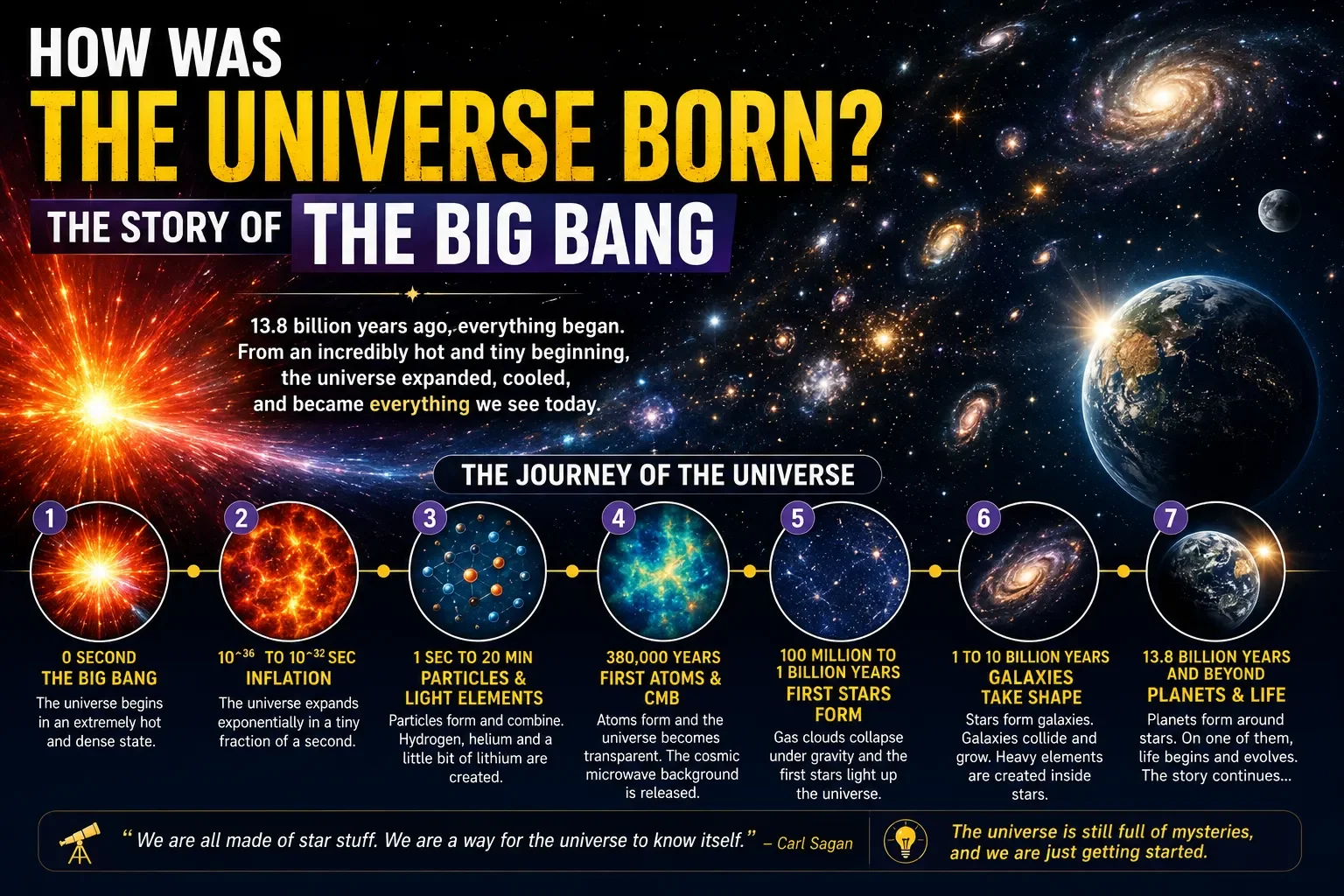
How Was the Universe Born? The Story of the Big Bang
17 Aug, 2026Imagine a time when there were no stars, no planets, no galaxies, no Earth—and not even the famili…
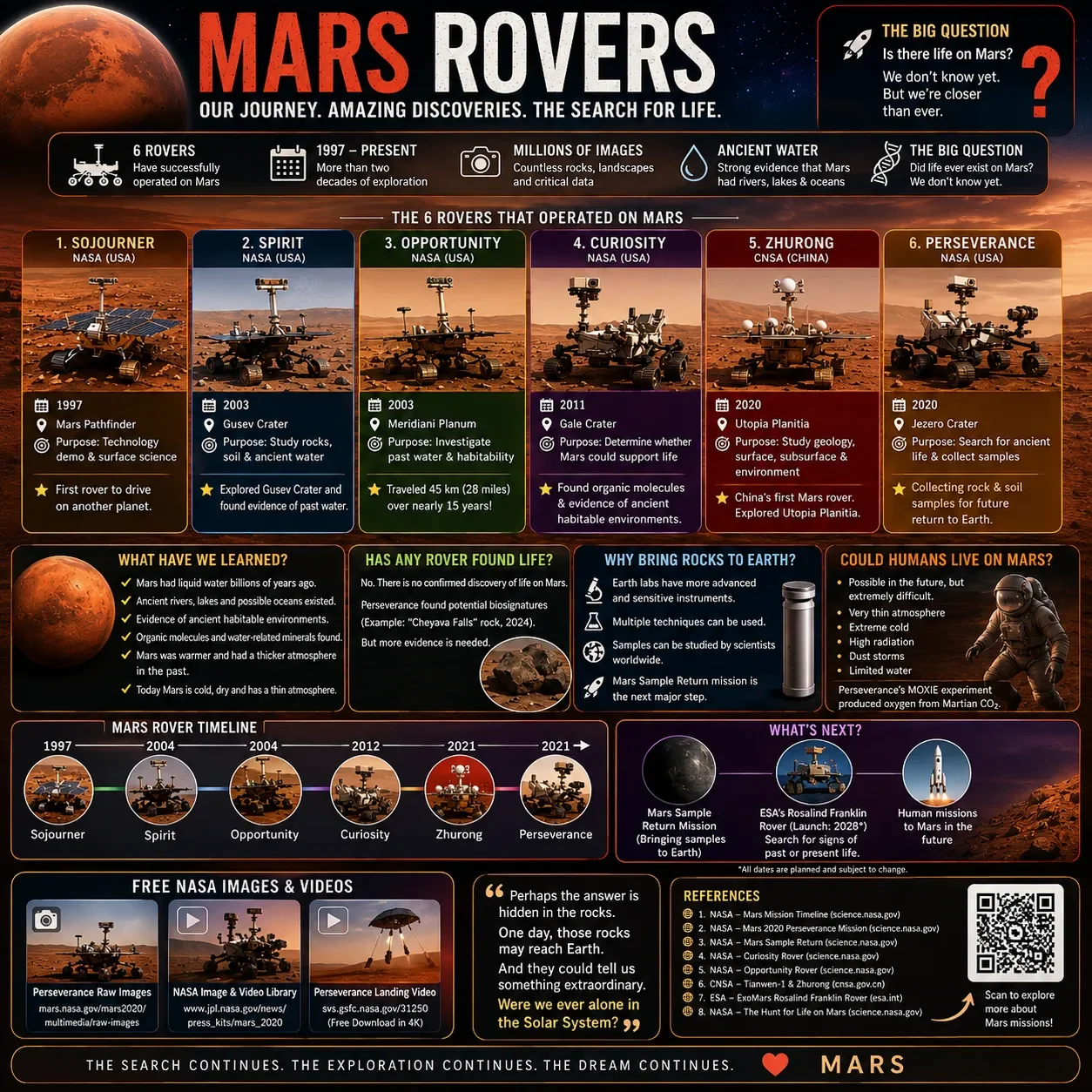
Mars Rovers: How Many Have Reached Mars, What Did They Discover, and Could Life Exist There?
17 Aug, 2026Mars has fascinated humans for centuries. Its reddish surface, ancient river-like channels, polar ic…
Reviews (0)
No reviews yet. Be the first!
Leave Feedback
Categories
- AI & Prompt Engineering 3
- Space Technology 3
- Tuition & Coaching 2
- Class 10 Tuition 2
- Online Classes 2
- Art & Craft 2
- Yoga 2
- Design & Multimedia 2
- Medical Entrance Coaching 1
- GRE Coaching 1
- Photography & Videography 1
- Cloud Computing (AWS, Azure, GCP) 1
- Data Science & Analytics 1
- Painting 1
- Digital Marketing & SEO 1
- Web Development 1
- DevOps & CI/CD 1
- Quantum Computing 1
- Cooking 1
- Exam Preparation 1
Tags
Recent Posts

The Path Beyond Suffering: Buddha’s Four Noble Truths, the Eightfold Way, and the Journey to Nirvana
02 Oct, 2026
Indian Philosophy and Philosophers: A Journey Through India’s Timeless Wisdom
30 Sep, 2026
GRE Coaching: Complete Guide to GRE Preparation, Classes, Fees & Career Opportunities
21 Aug, 2026
How Was the Universe Born? The Story of the Big Bang
17 Aug, 2026
Moon Missions: How Many Have Reached the Moon, Who Sent Them, and What Did We Discover?
17 Aug, 2026