Quantum Computing: A Complete Beginner's Guide to the Future of Computing
Category: Quantum Computing
Date: 09 Jun, 2026 | 240 views
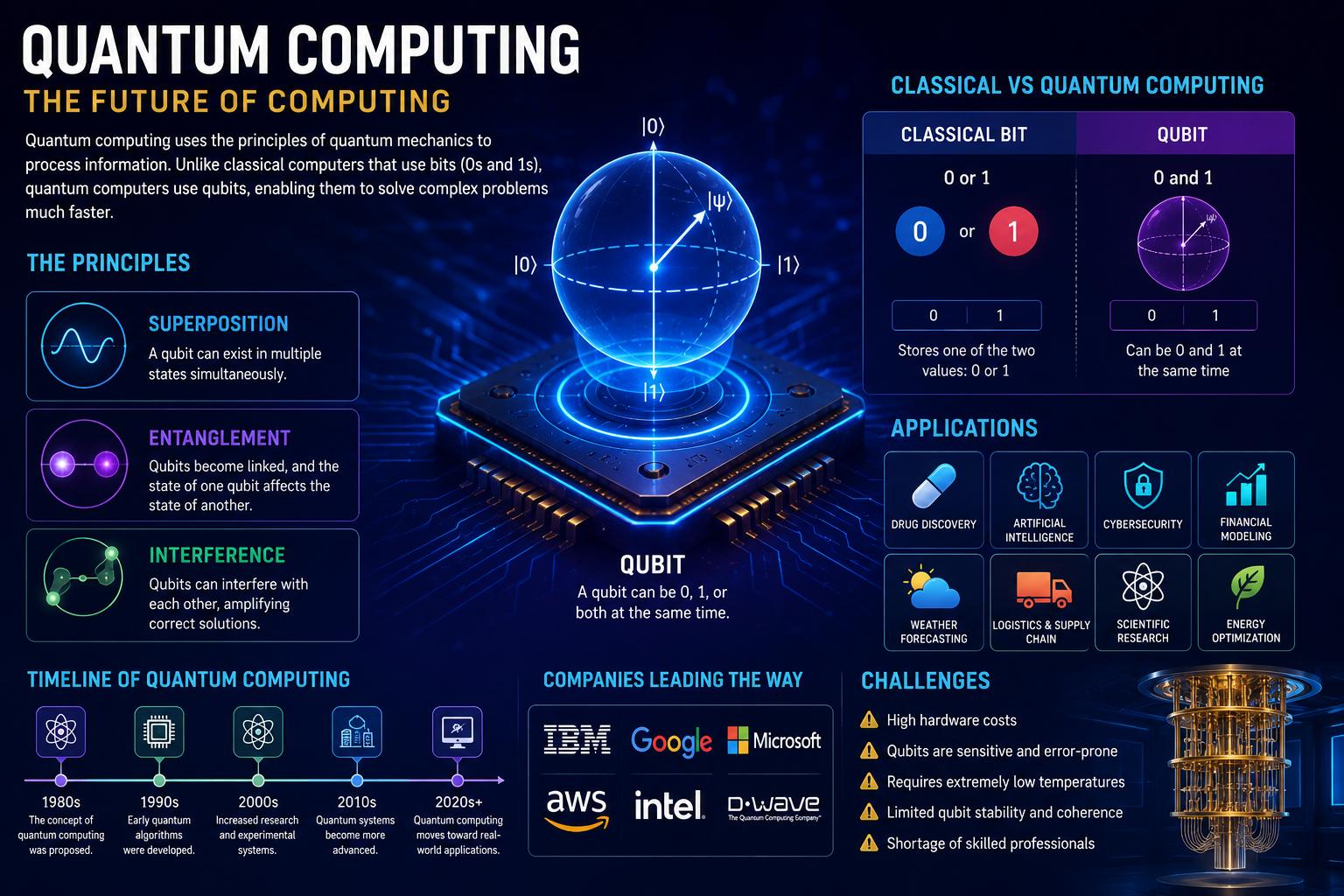
Quantum Computing is one of the most revolutionary technologies of the 21st century. Unlike traditional computers that process information using bits (0s and 1s), quantum computers use quantum bits (qubits), allowing them to solve complex problems much faster than classical computers. From drug discovery and artificial intelligence to cybersecurity and financial modeling, quantum computing has the potential to transform nearly every industry.
In this guide, we'll explore what quantum computing is, how it works, its advantages, challenges, real-world applications, and career opportunities. For more educational content, visit Education Setu.
What is Quantum Computing?
Quantum Computing is a branch of computer science that uses the principles of quantum mechanics to process information. While classical computers store information as bits (either 0 or 1), quantum computers use qubits, which can exist in multiple states simultaneously.
This unique capability allows quantum computers to perform many calculations at the same time, making them ideal for solving highly complex problems.
How Does Quantum Computing Work?
Quantum computers rely on three fundamental principles of quantum mechanics:
1. Qubits
A qubit is the basic unit of quantum information. Unlike a classical bit, a qubit can represent both 0 and 1 simultaneously.
2. Superposition
Superposition allows a qubit to exist in multiple states at once. This enables quantum computers to process vast amounts of information simultaneously.
3. Entanglement
Entanglement connects two or more qubits so that the state of one instantly affects the others, even over long distances. This improves computational efficiency.
Classical Computing vs Quantum Computing
| Feature | Classical Computer | Quantum Computer |
|---|---|---|
| Data Unit | Bit | Qubit |
| Values | 0 or 1 | 0, 1, or both simultaneously |
| Speed | Sequential processing | Massive parallel processing |
| Complex Calculations | Slower | Much faster |
| Applications | General computing | Scientific research, AI, cryptography |
Key Features of Quantum Computing
- Extremely high processing power
- Uses qubits instead of bits
- Parallel computation through superposition
- Solves complex mathematical problems efficiently
- Supports advanced simulations
- Potential to revolutionize artificial intelligence
- High-speed optimization algorithms
Applications of Quantum Computing
Artificial Intelligence
Quantum computing can significantly accelerate machine learning, pattern recognition, and AI model training.
Drug Discovery
Researchers can simulate molecular structures more accurately, reducing the time required to develop new medicines.
Cybersecurity
Quantum cryptography offers highly secure communication methods that are resistant to many traditional cyberattacks.
Financial Services
Banks and financial institutions can use quantum computing for portfolio optimization, fraud detection, and risk analysis.
Weather Forecasting
Quantum computers can process enormous climate datasets to improve weather prediction accuracy.
Logistics and Supply Chain
Businesses can optimize delivery routes, warehouse management, and inventory planning more efficiently.
Scientific Research
Quantum simulations help researchers understand complex chemical reactions, material science, and physics problems.
Advantages of Quantum Computing
- Solves highly complex problems faster
- Accelerates scientific research
- Improves artificial intelligence models
- Enhances optimization processes
- Better cybersecurity through quantum encryption
- Supports advanced simulations
- Faster data analysis
- Drives innovation across industries
Challenges of Quantum Computing
Despite its potential, quantum computing faces several challenges:
- Extremely expensive hardware
- Sensitive to environmental interference
- Difficult to maintain stable qubits
- Requires specialized cooling systems
- Limited availability of commercial quantum computers
- Shortage of skilled quantum professionals
Top Companies Working on Quantum Computing
Several leading technology companies are investing heavily in quantum computing, including:
- IBM
- Microsoft
- Intel
- Amazon Web Services (AWS)
- NVIDIA
- D-Wave Systems
- IonQ
- Rigetti Computing
Career Opportunities in Quantum Computing
As quantum technology advances, demand for skilled professionals is growing rapidly.
Popular career roles include:
- Quantum Software Developer
- Quantum Research Scientist
- Quantum Algorithm Engineer
- Quantum Hardware Engineer
- Machine Learning Engineer
- Data Scientist
- Cryptography Specialist
- Quantum Application Developer
Skills Required to Learn Quantum Computing
Students interested in quantum computing should develop knowledge in:
- Mathematics
- Linear Algebra
- Probability
- Quantum Mechanics
- Python Programming
- Computer Science
- Machine Learning
- Algorithms
- Data Structures
How to Start Learning Quantum Computing
Beginners can follow these steps:
- Learn basic computer science concepts.
- Study Python programming.
- Understand linear algebra and probability.
- Learn quantum mechanics fundamentals.
- Explore quantum programming frameworks such as Qiskit and Cirq.
- Practice using cloud-based quantum simulators.
- Build small quantum computing projects.
Future of Quantum Computing
Quantum computing is expected to become one of the most transformative technologies of the coming decades. It has the potential to solve problems that are currently impossible for classical computers, enabling breakthroughs in healthcare, finance, artificial intelligence, climate science, cybersecurity, and space exploration.
Although the technology is still developing, governments, universities, and major technology companies continue investing billions of dollars in quantum research.
Conclusion
Quantum Computing represents the next generation of computing technology. By leveraging the principles of quantum mechanics, it can process information in entirely new ways and solve complex problems much faster than traditional computers. While challenges remain, ongoing research and innovation are rapidly advancing the field.
For students, developers, researchers, and technology enthusiasts, learning quantum computing today can open exciting opportunities in one of the fastest-growing areas of science and technology. You can also explore more learning resources at Education Setu.
Frequently Asked Questions (FAQs)
1. What is Quantum Computing?
Quantum Computing is a technology that uses quantum mechanics to perform calculations using qubits instead of traditional bits.
2. What is a qubit?
A qubit is the basic unit of quantum information and can exist in multiple states simultaneously.
3. Is Quantum Computing better than Classical Computing?
For many highly complex problems, quantum computers have the potential to outperform classical computers. However, classical computers remain more practical for most everyday tasks.
4. Which programming language is used in Quantum Computing?
Python is the most widely used language for quantum programming, along with frameworks such as Qiskit and Cirq.
5. Is Quantum Computing a good career?
Yes. Quantum Computing is an emerging field with increasing demand for skilled professionals in research, software development, cybersecurity, and artificial intelligence.
Reviews (1) ★★★★★ 5/5
Fantastic content!
Prich Oth — 29 Jun 2026
★★★★★
Thank you for this detailed guide. It was exactly what I was looking for and solved my doubts.
Leave Feedback
Categories
- AI & Prompt Engineering 3
- Space Technology 3
- Tuition & Coaching 2
- Class 10 Tuition 2
- Online Classes 2
- Art & Craft 2
- Design & Multimedia 2
- GRE Coaching 1
- Photography & Videography 1
- Medical Entrance Coaching 1
- Cloud Computing (AWS, Azure, GCP) 1
- Data Science & Analytics 1
- Painting 1
- Digital Marketing & SEO 1
- DevOps & CI/CD 1
- Quantum Computing 1
- Web Development 1
- Cooking 1
- Exam Preparation 1
- Mobile App Development 0
Tags
Recent Posts

GRE Coaching: Complete Guide to GRE Preparation, Classes, Fees & Career Opportunities
21 Aug, 2026
How Was the Universe Born? The Story of the Big Bang
17 Aug, 2026
Moon Missions: How Many Have Reached the Moon, Who Sent Them, and What Did We Discover?
17 Aug, 2026
Mars Rovers: How Many Have Reached Mars, What Did They Discover, and Could Life Exist There?
17 Aug, 2026
Art and Craft: Creativity, Skills and Learning for Everyone
15 Aug, 2026