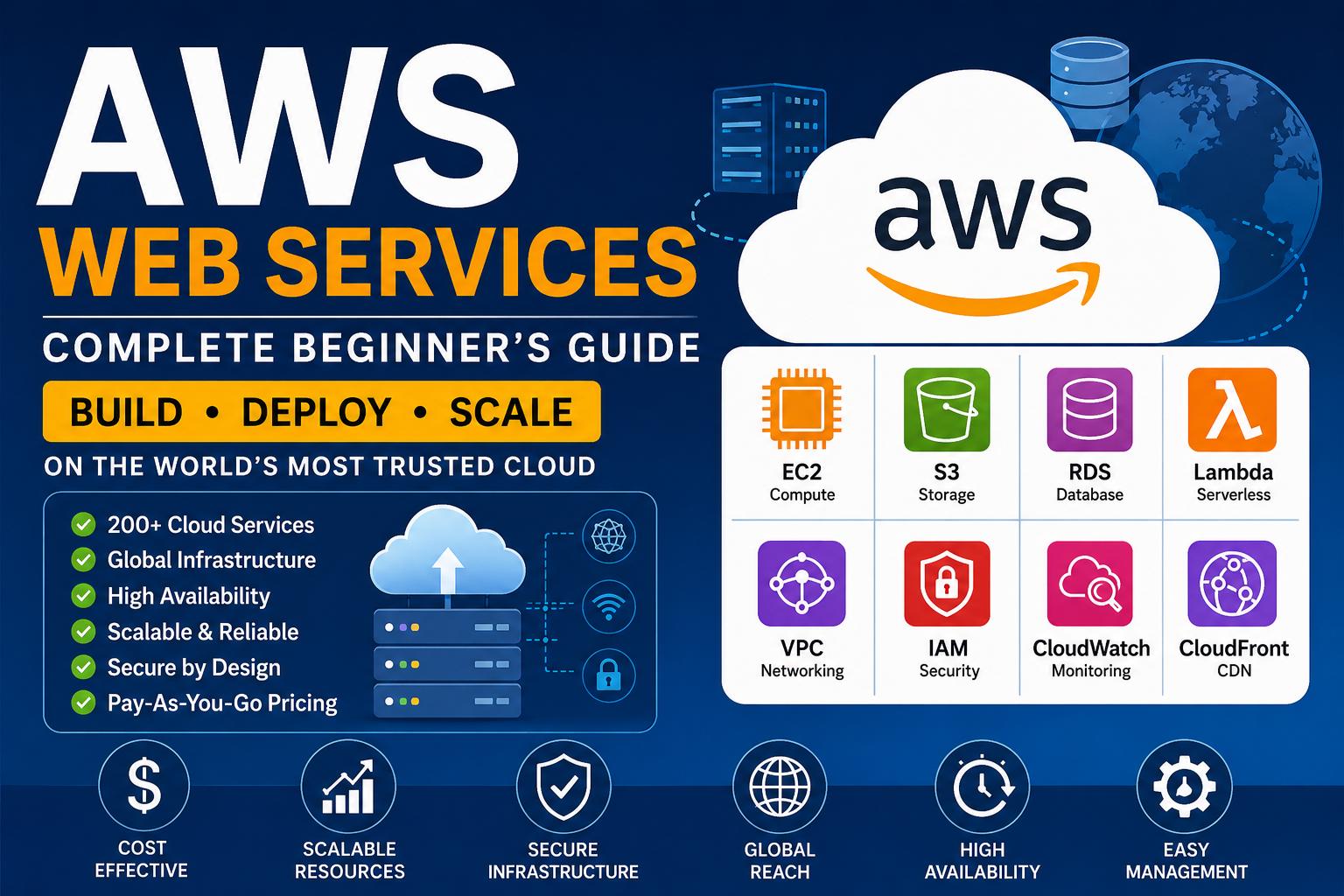
Amazon Web Services (AWS): Complete Guide for Beginners
Amazon Web Services (AWS) is the world's leading cloud computing platform that enables businesses, developers, startups, and enterprises to build scalable, secure, and reliable applications without investing in expensive physical infrastructure. Whether you're hosting a website, storing files, analyzing data, or building AI-powered applications, AWS provides the tools and services to help you succeed.
AWS is trusted by millions of customers worldwide because of its flexibility, global infrastructure, high availability, and pay-as-you-go pricing model.
What is AWS?
Amazon Web Services (AWS) is a cloud computing platform launched by Amazon in 2006. It provides over 200 cloud services, including computing power, storage, databases, networking, security, artificial intelligence, machine learning, analytics, Internet of Things (IoT), and much more.
Instead of purchasing expensive servers and networking equipment, organizations can rent AWS resources on demand and only pay for what they use.
Key Features of AWS
1. Pay-As-You-Go Pricing
AWS charges only for the resources you consume, helping businesses reduce infrastructure costs.
2. Global Infrastructure
AWS operates multiple Regions and Availability Zones across the globe, ensuring high availability and low latency.
3. Scalability
Applications can automatically scale resources up or down based on demand.
4. High Security
AWS provides enterprise-grade security with encryption, identity management, firewalls, and compliance certifications.
5. Reliability
AWS guarantees high uptime through redundant infrastructure and disaster recovery solutions.
6. Wide Range of Services
AWS offers more than 200 services covering nearly every cloud computing need.
Popular AWS Services
Amazon EC2
Elastic Compute Cloud (EC2) provides virtual servers that allow users to deploy applications quickly.
Uses:
Web hosting
Business applications
Game servers
Development environments
Amazon S3
Amazon Simple Storage Service (S3) is a highly durable cloud storage solution.
Uses:
Backup storage
Image hosting
Video storage
Static website hosting
Amazon RDS
Relational Database Service (RDS) helps users manage SQL databases without handling server maintenance.
Supports:
MySQL
PostgreSQL
MariaDB
SQL Server
Oracle
AWS Lambda
AWS Lambda enables developers to run code without managing servers.
Benefits:
Serverless computing
Automatic scaling
Pay only when code runs
Amazon CloudFront
CloudFront is AWS's Content Delivery Network (CDN) that delivers websites and media content quickly across the globe.
Amazon VPC
Virtual Private Cloud (VPC) allows businesses to create secure private cloud networks.
AWS IAM
Identity and Access Management (IAM) controls user permissions and resource access securely.
Amazon CloudWatch
CloudWatch monitors applications, servers, databases, and AWS resources in real time.
Benefits of AWS
Cost-effective infrastructure
High availability
Automatic scalability
Strong security
Fast deployment
Global reach
Easy backup and recovery
Continuous innovation
AWS Architecture
A basic AWS architecture includes:
Users
Route 53 (DNS)
Load Balancer
EC2 Instances
Auto Scaling
Amazon S3
RDS Database
CloudFront CDN
VPC Security
CloudWatch Monitoring
These components work together to create secure, scalable, and reliable cloud applications.
AWS Pricing Model
AWS follows a flexible pricing structure:
Free Tier for beginners
Pay-As-You-Go
Reserved Instances
Savings Plans
Spot Instances
This allows businesses to optimize costs based on their workloads.
Who Should Learn AWS?
Students
Software Developers
Web Developers
DevOps Engineers
System Administrators
Cloud Engineers
Data Engineers
Cybersecurity Professionals
AI & Machine Learning Engineers
AWS Career Opportunities
AWS skills are highly valued across industries.
Popular job roles include:
AWS Cloud Engineer
DevOps Engineer
Cloud Architect
Solutions Architect
Site Reliability Engineer
Cloud Consultant
System Administrator
Cloud Security Engineer
AWS-certified professionals often earn competitive salaries due to strong industry demand.
AWS Certifications
Popular AWS certifications include:
AWS Certified Cloud Practitioner
AWS Certified Solutions Architect – Associate
AWS Certified Developer – Associate
AWS Certified SysOps Administrator
AWS Certified DevOps Engineer
AWS Certified Security – Specialty
These certifications validate cloud expertise and enhance career prospects.
Advantages of AWS
Trusted by millions of businesses
Secure cloud infrastructure
Automatic backups
Global data centers
High-speed performance
Flexible pricing
Continuous updates
Easy integration with modern technologies
Disadvantages of AWS
Large number of services can be overwhelming for beginners.
Costs may increase without proper monitoring.
Some advanced services have a learning curve.
Vendor lock-in may occur if applications rely heavily on AWS-specific features.
Conclusion
AWS (Amazon Web Services) has transformed the way businesses build, deploy, and manage applications in the cloud. With its extensive portfolio of cloud services, global infrastructure, robust security, and flexible pricing, AWS is an excellent choice for organizations of all sizes.
Whether you're just beginning your cloud journey or aiming to become a cloud professional, learning AWS can open the door to exciting career opportunities and help you build scalable, modern applications.
Frequently Asked Questions (FAQs)
1. What is AWS?
AWS (Amazon Web Services) is Amazon's cloud computing platform that provides on-demand services such as computing, storage, databases, networking, AI, and analytics.
2. Is AWS free?
AWS offers a Free Tier with limited usage for eligible services. Beyond those limits, charges are based on actual usage.
3. Which AWS service is used for storage?
Amazon S3 is the most popular object storage service provided by AWS.
4. What is Amazon EC2?
Amazon EC2 is a virtual server service that lets users deploy and manage applications in the cloud.
5. Is AWS good for beginners?
Yes. AWS provides beginner-friendly documentation, tutorials, a Free Tier, and learning paths, making it a great platform to start learning cloud computing.
SEO Information
Focus Keyword: AWS Web Services
Secondary Keywords: Amazon Web Services, AWS Cloud, AWS Tutorial, AWS Services, Cloud Computing, AWS Certification, Amazon EC2, Amazon S3, AWS for Beginners.